
20 February 2014


12 February 2014

09 February 2014
Outdoor Explorations: Rattlesnake Ski Day
Winter has returned to western Montana, and we snow-lovers are thrilled. To many of us, to wake up to 6" of new, fluffy snow means one thing on a fine weekend day: we have to get out into it. My husband and I donned our layers and, armed with chocolate, water, a thermos of tea, and several eggy-avocado-y burritos, headed up to the Rattlesnake Recreation Area, where the parking lot was almost full and the snow was still falling. Two weeks ago the main trail was a sheet of ice, only ideal if one's goal was broken bones or bruises . . . but a foot of snow later, all is transformed.
 |
| photo by Allison De Jong |
 |
| photo by Allison De Jong |
 |
| photo by Allison De Jong |
 |
| photo by Allison De Jong |
 |
| photo by Allison De Jong |
 |
| photo by Allison De Jong |
What are your favorite winter activities? Where do you love to go to see wintry beauty at its finest?
07 February 2014
Friday Field Notes: Winter Gemütlichkeit
 |
| Photo: Ryan Milling |
Snow is probably number 2 on my list of enjoyable frozen things (number 1, of course, occupied by ice cream). Snow affords us fantastic opportunities to enjoy nature. Skiing, sledding, snowshoeing, frolicking, track identifying, snowflake admiring...
The list goes on.
I usually like to share my experiences in wild snowy places and I always experience a distinct emotion that I feel the English language has no single word to describe. The Germans must have spent some serious time in the snowy Black Forest or Alps with their friends and loved ones to come up with this word: Gemütlichkeit. The word describes a sense of kinship and coziness but also a feeling of unhurriedness and sense of place.
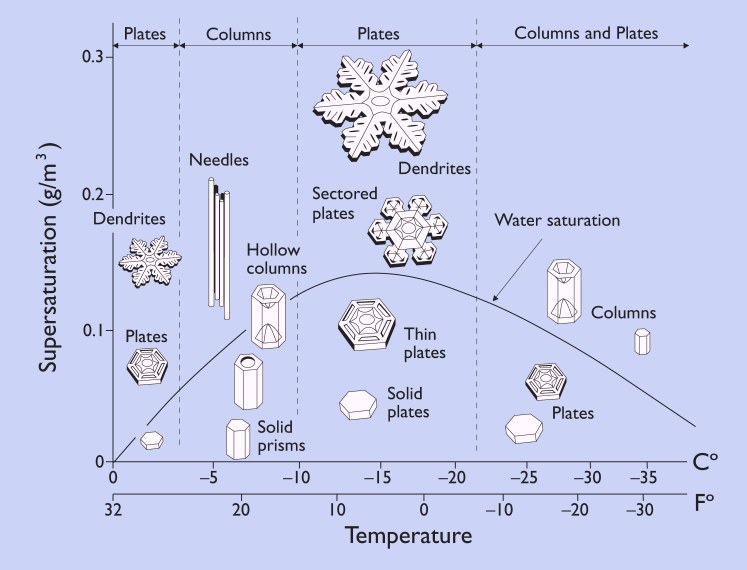
The old adage goes "no two snowflakes are alike"--and that's pretty much true! The length of each arm of a snowflake is determined by its immediate environmental conditions (mainly temperature and moisture in the air: warmer/wetter = longer spindly flakes, colder/drier = shorter, more plate-like flakes). Each snowflake has minute differences in its immediate environment and so each one branches at a different point, or grows a different length, etc.
 |
| 6-fold symmetry of ice crystals. |
Snowflakes get their distinct 6-fold symmetry from the molecular structure of ice crystals, which is also a 6-fold symmetry. The ice crystals build on each other until the snowflake itself mirrors its molecular structure.
I suppose ultimately each individual snowflake is a collection (maybe even a companionship) of ice crystals, making a journey together towards the earth, and landing in just the right places for us to enjoy.
 |
| Photo: Ryan Milling |
04 February 2014

31 January 2014
Friday Field Notes: Chinook Winds of Fortune
On my ride into the Montana Natural History Center this morning there was one thing that was impossible not to think about: WIND. Struggling against a current of wind on an icy bike path is no cakewalk. Missoula doesn't get this windy too often, but just a handful of miles across the Continental Divide onto Montana's high plains, it's another story.
Most of Montana is occupied by rolling grasslands, once dominated by bison, pronghorn, and prairie dogs. Beautiful shortgrass prairie stretched from the flanks of the Rockies and moated the island ranges of the central and eastern parts of the state. The rich soils that sustained the plentiful life were also ideally suited for growing crops like wheat and alfalfa and stock grazing. A short time after the advent of white settlers, much of the prairie had been checkered with farms and fences, altering the pristine landscape into an anthropomorphized version of its former self.
Weather, however, remains indifferent to our terrestrial tillings, not appearing to care about our comfort or chapped faces.
Wind has played an important role in Montana's history, particularly on the eastern slope of the Rockies. From harnessing wind for energy production, to dispersal of seeds and pollen for various plants, wind, despite its indifference, is critical for life on the prairie.
Chinook winds have certainly made their mark on Montana history. A Chinook wind a is warm, dry air mass that rips down the east slope of high mountains and warms the plains it crosses. Chinooks form from westerly humid cells of air from the Pacific that dump their moisture on the west sides of mountain ranges (the great and mighty Rockies in our case), then warm adiabatically on their way back down the eastern side. The Chinook winds reach temperatures up to 60 degrees F and tear across that landscape at speeds up to 100 mph, melting and sublimating snow in their wake.
These winds are most common and severe from Cutbank to Helena, Montana. The high, steep eastern slopes of Glacier and the Bob Marshall and Scapegoat Wildernesses warm more quickly. The greatest temperature change in a 24-hour period in the U.S. was due to a Chinook wind, and occurred in Loma, Montana. The temperature went from -54 to 49 F, a 103-degree change! It is plain to see that ranchers would have relied on these remarkable weather events to make it through the unforgiving winters that punctuate every year in central Montana.
Most of Montana is occupied by rolling grasslands, once dominated by bison, pronghorn, and prairie dogs. Beautiful shortgrass prairie stretched from the flanks of the Rockies and moated the island ranges of the central and eastern parts of the state. The rich soils that sustained the plentiful life were also ideally suited for growing crops like wheat and alfalfa and stock grazing. A short time after the advent of white settlers, much of the prairie had been checkered with farms and fences, altering the pristine landscape into an anthropomorphized version of its former self.
 |
| Looking out from Square Butte towards the Missouri River Breaks |
Wind has played an important role in Montana's history, particularly on the eastern slope of the Rockies. From harnessing wind for energy production, to dispersal of seeds and pollen for various plants, wind, despite its indifference, is critical for life on the prairie.
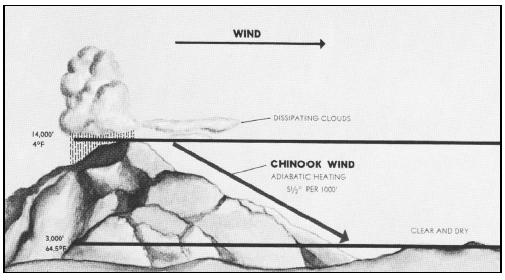
Chinook winds have certainly made their mark on Montana history. A Chinook wind a is warm, dry air mass that rips down the east slope of high mountains and warms the plains it crosses. Chinooks form from westerly humid cells of air from the Pacific that dump their moisture on the west sides of mountain ranges (the great and mighty Rockies in our case), then warm adiabatically on their way back down the eastern side. The Chinook winds reach temperatures up to 60 degrees F and tear across that landscape at speeds up to 100 mph, melting and sublimating snow in their wake.
 |
| http://www.weatherexplained.com/images/walm_01_img0191.jpg |
 |
| Waiting for a Chinook by Charlie Russell |
As I bike back home today against that not-so-warm wind coming out of the mouth of Hellgate Canyon, I'll be dreaming of warm, dry Chinooks on the prairie.
30 January 2014
Nature Notes: Tracking in the Seeley Lake Region
Oh, Animal Tracks
Left in the Snow
You provide a Story
that I so long to know.
But with time and patience
I can follow each track
leading me to find you
at the back of the pack.

Subscribe to:
Posts (Atom)