During my visit back east I was reminded of how wonderful my parents' backyard is for observing birds and small critters. As I sat on my parents' back porch I was ecstatic to see a number of Black-capped Chickadees, one of my favorite birds in Montana, as they quickly swooped down from the shrubs and large oak tree towards the bird feeder that my parents had positioned in the backyard when I was just a child. Ever since its placement in our backyard, the bird feeder has always attracted Eastern gray squirrels. It still puts a smile on my face to watch the squirrels scurry about, as they gather the birds' littered seeds off of the ground.
Showing posts with label Birds. Show all posts
27 December 2013
29 March 2013
Friday Field Notes: Bluebird Days
Lately, it seems as if the sky is blue more often than not. There is nothing quite like waking up to a brisk, bluebird day in the spring in Montana. The growing strength of the sunshine warms the skin and raises hope that summer is not far away. But it isn't just the sun that illuminates the landscape this time of year.
On a recent outing up Missoula's Waterworks Hill, I heard a soft, chattery whistle sound. Initially, I was caught off-guard, but rather quickly it hit me: Mountain Bluebirds. I panned around, searching for the magnificent cerulean birds, and sure enough, there they were perched on a power line right above me. I don't know why I was so surprised to see them; the sweeping grasslands are perfect bluebird habitat that the birds return to every year. Perhaps it was simply the abruptness with which they arrived. The previous day, there were no bluebirds to be found. Now, there were dozens.
Mountain Bluebirds (Sialia currocoides) are a small member of the thrush family, which includes common birds like the American Robbin, Hermit Thrush, Townsend's Solitaire, and other bluebirds. While common throughout Montana and most of the interior West in the spring and summer, Mountain Bluebirds move as far south as Central America to winter. Rather interestingly, Mountain Bluebirds can tolerate colder habitats than other bluebirds, and some migrate westward to the Sierras for the winter. I suppose they must be pretty hearty, as their early return to the Northern Rockies inevitably results in them being forced to weather a handful of spring snowstorms.
Unlike many bird species, Mountain Bluebirds have largely benefited from human settlement and activity in the West. The clearing of previously forested lands and the expansion of agricultural development has opened up millions of acres of new bluebird habitat. They also have been helped by our affinity for them - there must be hundreds of thousands of "bluebird boxes" scattered across the western United States.
Like most thrushes, Mountain Bluebirds feed primarily on insects, although their diet is supplemented throughout the year with small fruits and seeds. What sets this particular bird apart from its close relatives, however, is the way in which they sometimes acquire their food. Mountain Bluebirds can often be seen hovering in place, not unlike American Kestrels, as they scan the ground for insects. If prey is found, they quickly swoop down to the ground like a raptor pouncing on a small rodent. It is a spectacular sight to behold, made all the wilder and more intense by the bird's stunning colors.
Over the coming days and weeks, more and more of these magnificent birds are sure to arrive. Their presence on Waterworks Hill and other grassy fields across Montana is likely to be accompanied by that of a close rival, the Western Bluebird. As mating season takes off and the struggle to establish a territory reaches fever pitch, Mountain Bluebirds will clash with Westerns as well as members of their own species over nesting boxes and territories. It will be a spectacle, no doubt. I, for one, will be watching eagerly.
Have you seen any bluebirds yet this spring? Do your bluebird boxes have new residents? Be sure to let us know in the comments!
On a recent outing up Missoula's Waterworks Hill, I heard a soft, chattery whistle sound. Initially, I was caught off-guard, but rather quickly it hit me: Mountain Bluebirds. I panned around, searching for the magnificent cerulean birds, and sure enough, there they were perched on a power line right above me. I don't know why I was so surprised to see them; the sweeping grasslands are perfect bluebird habitat that the birds return to every year. Perhaps it was simply the abruptness with which they arrived. The previous day, there were no bluebirds to be found. Now, there were dozens.
![]() |
| A male Mountain Bluebird with his lunch. |
Unlike many bird species, Mountain Bluebirds have largely benefited from human settlement and activity in the West. The clearing of previously forested lands and the expansion of agricultural development has opened up millions of acres of new bluebird habitat. They also have been helped by our affinity for them - there must be hundreds of thousands of "bluebird boxes" scattered across the western United States.
![]() |
| A female Mountain Bluebird hovers while searching for insects. |
Over the coming days and weeks, more and more of these magnificent birds are sure to arrive. Their presence on Waterworks Hill and other grassy fields across Montana is likely to be accompanied by that of a close rival, the Western Bluebird. As mating season takes off and the struggle to establish a territory reaches fever pitch, Mountain Bluebirds will clash with Westerns as well as members of their own species over nesting boxes and territories. It will be a spectacle, no doubt. I, for one, will be watching eagerly.
Have you seen any bluebirds yet this spring? Do your bluebird boxes have new residents? Be sure to let us know in the comments!
19 March 2013
Friday Field Notes: Sounds of Spring
There are few better harbingers of spring in North America than the millions of birds that begin to arrive and sing about this time each year. Sure, an arbitrary date on the Julian calendar and the act of changing our clocks alerts us to the coming season, but nothing signals the actual arrival of spring and its warmer weather quite like birds and their songs do. And much to my delight, all kinds of birds are beginning to "spring" up around Montana.
The first sign for me that migration was underway occurred about ten days ago, when I awoke to the sound of an emphatic Killdeer in my yard. Although these shorebirds are year-round residents of western Montana's valley bottoms, this particular pair seems to take off for greener pastures every year in late September, only to return to the same exact spot sometime in March. It was a surprising but welcome event.
Not long after this punctual plover showed up, I noticed that there was a sudden influx of robins in the area. Like Killdeer, the American Robin is also a year-round resident, but only a handful stick around and brave the winter. Come late February/early March, large flocks of these renowned "early birds" begin to invade. It is safe to say that our lawns and parks will be worm-free any day now.
The first sign for me that migration was underway occurred about ten days ago, when I awoke to the sound of an emphatic Killdeer in my yard. Although these shorebirds are year-round residents of western Montana's valley bottoms, this particular pair seems to take off for greener pastures every year in late September, only to return to the same exact spot sometime in March. It was a surprising but welcome event.
| One of my squatters on his first day back. |
The surest sign of spring I've received thus far came only a week ago. At the crack of dawn, a Song Sparrow who managed to spend all winter in my backyard began singing his complex, melodic song in an attempt to impress a nearby female. His choruses were joined by dozens of hopeful Black-Capped Chickadees belting our their unmistakable "cheese-bur-ger" song. Then, out of nowhere, I noticed a Spotted Towhee vigorously scratching through leaves and dirt, likely searching for a suitable place to nest.
There have also been a few oddities that have signaled change is in the air. That same day, a small flock of Pine Grosbeaks joined the raucous group of birds around my home, likely beginning their trip up to the higher elevations where they breed. Even more shocking was the sight of a Mountain Chickadee on my feeder and a Townsend's Solitaire taking a bath in my gutter, sure indications that birds are moving around and transitioning from winter to summer habitat.
All of this recent bird activity around my home in Missoula coincides with the wealth of observations from around the state of Red-winged Blackbirds beginning to sing and court. It is only a matter of time, really, until Western Meadowlarks arrive and grace us with their bubbly verses. I'll really be a believer, though, when Mountain Bluebirds return to paint our hillsides the color of the sky.
What's going on in your backyard? We'd love to hear from you in the comments!
01 March 2013
Friday Field Notes: A Bohemian Rhapsody
I see a little silhuetto of a bird,
It's got a crest! It's got a crest!
And a beautiful masked face!
... And waxy yellow tips on its wings?
I'll admit it: that was cheesy, at best. But the timing of this this naturalist-inspired Queen spoof is perhaps perfect. As winter crawls along, thousands of Bohemian Waxwings fill the valleys of western Montana with their sweet trill. Yet not every winter presents such a great opportunity to see them (indeed, their name "Bohemian" lends credence to their extremely nomadic nature), so it's worth taking advantage of the recent influx of these magnificent birds while they're here.
Bohemian Waxwings (Bombycilla garrulus) are one of three large passerine species that belong to family "Bombycillidae," commonly known as the Waxwings. The other two - Cedar Waxwings and Japanese Waxwings (native to Japan - surprised?) - are very similar in appearance to the Bohemian. Bohemian Waxwings (like their close cousins) inhabit temperate coniferous and mixed forests, and feed primarily on fleshy fruits and berries, though gleaning for insects becomes a primary summer feeding behavior. Interestingly, Bohemian Waxwings do not establish breeding territories, likely because the fruits they depend on are abundant during breeding season. As a result, these birds have no true songs, communicating almost entirely through their high-pitched trill.
While Cedar Waxwings are found in Montana year-round, Bohemians - outside of a small sliver in the northwestern-most corner of the state - only occur in winter. Thus, Bohemian Waxwings and Cedar Waxwings are both present in winter in Montana, and the two species frequently form mixed flocks. Hence, the problem: How does one tell apart these two extremely similar birds?
![]() |
| Cedar Waxwing top right; lower two birds are Bohemian Waxwings. |
Of course, you aren't very likely to get this good of a look at the two species side-by-side, as they are notorious for their constant gleaning and fluttering about. This is where being able to tell the difference in their call can be useful. As you listen to the Bohemian Waxwing's high-pitched trill (http://www.allaboutbirds.org/guide/bohemian_waxwing/sounds), be sure to listen carefully, as you can hear each individual note in the call. Cedar Waxwings, by comparison, have a nasally, high-pitched whistle (http://www.allaboutbirds.org/guide/Cedar_Waxwing/sounds) which resembles more of a single "bzeeee" note. While at first the two calls sound very similar, you will quickly pick up on the subtle differences between the two.
Hopefully this crash course in waxwing identification helps you in your future birding pursuits. At the very least, you now know that Queen's "Bohemian Rhapsody" can be laughably re-mixed to accommodate birds and natural history topics!
Have you seen or heard any Bohemian Waxwings this winter? Be sure to let us know!
14 December 2012
Friday Field Notes: The (un)Common Redpoll
A few days ago, an unusual bird showed up in my backyard. I could tell immediately from its size, shape, and plumage that it was a small finch. Overall, it was a fairly plain bird, with plenty of brown stripes and a noticeable white wing bars, not far different from a Pine Siskin. But, whenever the bird turned its head in my direction, it revealed a bright, slightly iridescent red patch just above its eyes. It could only be one thing: a Common Redpoll!
The name is a bit of a misnomer. Sure, if you live in a mountain valley in Alaska or northern Canada, you might see Redpolls as frequently as Chipping Sparrows. But in Montana, these birds only show up sporadically in the winter. A member of the "winter finch" clan, the Cornell Lab of Ornithology describes Common Redpolls as "erratic" migrators, sometimes ending up in places as unusual Arkansas or New Jersey. In irruption years (which this year is certainly shaping up to be), Common Redpolls, along with a variety of other finches and sparrows (and birds of prey - who can forget last year's Snowy Owl surprise?!) move far south of what would be considered their typical range, driven by a scarcity of food.
Year-round, redpolls are incredibly social birds, sometimes found in flocks of 300 individuals. Even during breeding season, it is not uncommon for multiple pairs of redpolls to nest fairly close together and show a lack of territoriality. Redpolls feed almost exclusively on seeds, and hence, are likely to show up where there is a bird feeder. To increase your chances of attracting a redpoll to your backyard, tempt these birds with thistle or nyjer seeds.
Have you seen a Common Redpoll or any other surprising visitors this winter? Be sure to let us know if you do!
The name is a bit of a misnomer. Sure, if you live in a mountain valley in Alaska or northern Canada, you might see Redpolls as frequently as Chipping Sparrows. But in Montana, these birds only show up sporadically in the winter. A member of the "winter finch" clan, the Cornell Lab of Ornithology describes Common Redpolls as "erratic" migrators, sometimes ending up in places as unusual Arkansas or New Jersey. In irruption years (which this year is certainly shaping up to be), Common Redpolls, along with a variety of other finches and sparrows (and birds of prey - who can forget last year's Snowy Owl surprise?!) move far south of what would be considered their typical range, driven by a scarcity of food.
![]() |
| A Common Redpoll in winter plumage. |
Year-round, redpolls are incredibly social birds, sometimes found in flocks of 300 individuals. Even during breeding season, it is not uncommon for multiple pairs of redpolls to nest fairly close together and show a lack of territoriality. Redpolls feed almost exclusively on seeds, and hence, are likely to show up where there is a bird feeder. To increase your chances of attracting a redpoll to your backyard, tempt these birds with thistle or nyjer seeds.
Have you seen a Common Redpoll or any other surprising visitors this winter? Be sure to let us know if you do!
09 November 2012
Friday Field Notes: Winter Birding
The osprey are on winter break in the Bahamas, and the warblers are even further south, soaking up the sun and warm temperatures of central America. As for us? Well, we are faced with the reality of our first significant snow storm of the year in Montana. Winter is long and cold in our great state, and that's why many of the more than 300 avian species that call Montana home for part of the year pack their bags and hit the road (or should I say the airways?). Despite this, winter can still be an incredible time to go birding. Here are some tips to help get you through the cold, snowy months ahead:
- Put out a feeder! The bears are just about gone, and birds are now having to look harder to find critical winter food sources. Once one bird finds your feeder, they all do, and they will stay as long as you keep it filled. Platform feeders are a fantastic option - they attract a wide range of birds, from chickadees to grosbeaks, and they provide an excellent opportunity to get a close-up look at the bird.
- Go for a walk in an area with lots of deciduous trees. Birders often joke during spring migration, "If only those darn leaves didn't get in the way of the birds!" Well, now that the leaves have fallen off the trees, they don't. Brilliant, colorful birds like Evening Grosbeaks, Cedar Waxwings, and House Finches who spend much of their time in trees and shrubs are now strikingly obvious, and the views are unobstructed.
- Don't forget about water. The rich, diverse riparian habitat that lines our streams and rivers and attracts dozens of species in the spring and summer is still filled with birds in the winter. Iconic birds like American Dippers, Great Blue Herons, and Bald Eagles never leave, and winter can be as good a time as any to view them.
- When the snow rolls in, so do the birds. Significant snow storms push birds that typically spend their time at higher elevations (Clark's Nutcrackers, Steller's Jays, and Gray Jays, among others) lower into valleys. Additionally, the snow-covered ground makes it difficult for seed-eating birds (finches, sparrows) to find the food they need. Suddenly, your feeder becomes a wild bird refuge!
What are your winter birding tips? What birds have you been seeing? Share your observations in the comments!
- Put out a feeder! The bears are just about gone, and birds are now having to look harder to find critical winter food sources. Once one bird finds your feeder, they all do, and they will stay as long as you keep it filled. Platform feeders are a fantastic option - they attract a wide range of birds, from chickadees to grosbeaks, and they provide an excellent opportunity to get a close-up look at the bird.
- Go for a walk in an area with lots of deciduous trees. Birders often joke during spring migration, "If only those darn leaves didn't get in the way of the birds!" Well, now that the leaves have fallen off the trees, they don't. Brilliant, colorful birds like Evening Grosbeaks, Cedar Waxwings, and House Finches who spend much of their time in trees and shrubs are now strikingly obvious, and the views are unobstructed.
- Don't forget about water. The rich, diverse riparian habitat that lines our streams and rivers and attracts dozens of species in the spring and summer is still filled with birds in the winter. Iconic birds like American Dippers, Great Blue Herons, and Bald Eagles never leave, and winter can be as good a time as any to view them.
- When the snow rolls in, so do the birds. Significant snow storms push birds that typically spend their time at higher elevations (Clark's Nutcrackers, Steller's Jays, and Gray Jays, among others) lower into valleys. Additionally, the snow-covered ground makes it difficult for seed-eating birds (finches, sparrows) to find the food they need. Suddenly, your feeder becomes a wild bird refuge!
| A flock of Evening Grosbeaks weathers a storm. |
| An Evening Grosbeak |
28 October 2012
Friday Field Notes: Who's Watching Hoooo(m)?
Have you ever had the experience of coming face to face with an owl?
Incredible birds for a variety of reasons, including their elusive nature, adept hunting skills, and haunting calls, owls have long captured the human imagination. Stories about owls have been passed down for thousands of years in numerous cultures, and even today we assign them meaning (mystery, cunning, wisdom) and relate to them in profound ways.
What I have been most touched by, however, is the way in which owls seem to gaze back at us with the same intent with which we look upon them. The thrill of seeing a bear or moose or eagle is undeniable, but these animals often do little more than acknowledge our presence before dismissing us as a non-threat and moving on to whatever they were doing before we disturbed them. Owls, by comparison, appear to stare directly at us, appear to be going through a series of complex thoughts and judgements. I have sometimes felt as if the bird is actually peering directly into my soul. Sure, many animals display extreme senses of curiosity (especially American Martens), but owls are doing more than checking out what we're up to; they're breaking us down and sizing us up. Maybe I am anthropomorphizing a bit too much; but maybe owls are even more intelligent and complex than we give them credit for.
I am led to believe that owls watch and study us in ways most other animals do not, ways that we do not truly understand. This places us in unusual position, one in which many people would not be comfortable: as humans, we are usually the ones placing other animals under the microscope, not vice versa. So the experience of coming face to face with an owl (especially a large one) can be fairly humbling and eye-opening.
Standing eye-to-eye with an owl stirs up ancient and primal emotions, transporting us to times when we were a bit closer to the world around us. It forces us to re-evaluate our assumptions about nature. It poses much larger questions, none more relevant than: Who's watching whom?
Incredible birds for a variety of reasons, including their elusive nature, adept hunting skills, and haunting calls, owls have long captured the human imagination. Stories about owls have been passed down for thousands of years in numerous cultures, and even today we assign them meaning (mystery, cunning, wisdom) and relate to them in profound ways.
What I have been most touched by, however, is the way in which owls seem to gaze back at us with the same intent with which we look upon them. The thrill of seeing a bear or moose or eagle is undeniable, but these animals often do little more than acknowledge our presence before dismissing us as a non-threat and moving on to whatever they were doing before we disturbed them. Owls, by comparison, appear to stare directly at us, appear to be going through a series of complex thoughts and judgements. I have sometimes felt as if the bird is actually peering directly into my soul. Sure, many animals display extreme senses of curiosity (especially American Martens), but owls are doing more than checking out what we're up to; they're breaking us down and sizing us up. Maybe I am anthropomorphizing a bit too much; but maybe owls are even more intelligent and complex than we give them credit for.
| A Great Gray Owl sizing me up. |
I am led to believe that owls watch and study us in ways most other animals do not, ways that we do not truly understand. This places us in unusual position, one in which many people would not be comfortable: as humans, we are usually the ones placing other animals under the microscope, not vice versa. So the experience of coming face to face with an owl (especially a large one) can be fairly humbling and eye-opening.
| A Snowy Owl checking me out from a somewhat unusual vantage point: a roof. |
Standing eye-to-eye with an owl stirs up ancient and primal emotions, transporting us to times when we were a bit closer to the world around us. It forces us to re-evaluate our assumptions about nature. It poses much larger questions, none more relevant than: Who's watching whom?
19 October 2012
Friday Field Notes: Photo Essay: Fall in Montana
| The icy cold waters of Avalanche Creek in Glacier National Park continue to carve through ancient rock. |
| Aspens paint the hillsides gold near East Glacier. |
| A grizzly print high in the Absarokas, an indication that these creatures are moving up in elevation to feed on critical fall food sources like whitebark pine seeds. |
| Rattlesnake Creek takes on many moods on an overcast day. |
| Much-needed moisture relieves the strain of a hot, dry summer throughout the West. |
| Sunlight slices through storm clouds to pit a shimmering aspen against the backdrop of an ominous sky. |
| Red meets gold in the understory of the subalpine forest. |
| A beaver works diligently to ensure all is in place before yet another make-or-break winter arrives. |
| The sight of snow atop rocky peaks reminds us that winter is never too far away. |
28 September 2012
Friday Field Notes
The beautiful weather of late has kept me from dragging winter clothes out from the depths of my closet, and has instead forced me to continue enjoying what nature has to offer. Here's some notes, observations, and photographs from a recent trip up to Glacier National Park:
| Colors across the spectrum. |
Fall foliage is really starting to take off. The aspens (Populus tremuloides) are shimmering gold, or are quite close to it. Plants of the understory, such as grouse whortleberry (Vaccinium scoparium) and huckleberry (Vaccinium membranaceum), fill the hillsides with shades of red and orange. Contrasted against the rich greens of conifers, the deep grays and purples of the ancient sedimentary cliffs, and the regal blues of Glacier's many alpine lakes, hiking in the park these days is like walking through a dreamland. I don't know that I have ever seen so many colors on display at once!
Bears
If you've ever been to a national park - especially one inhabited by grizzlies - you know how serious the National Park Service is when it comes to bears and safety. This time of year, the message is even more important. As bears prepare for hibernation in late summer and early fall, they enter into hyperphagia, a status literally of excessive hunger and consumption. Feeding primarily on berries, insects, and whitebark pine seeds, bears can easily consume over 15,000 calories per day. The need to constantly find more food and pack on fat leads to bears being particularly active this time of year, and as a result, increases the likelihood of an encounter with a bear. Two days in Glacier yielded three grizzly sightings, one of which was an adult male that essentially popped out of nowhere a mere fifty feet from me while hiking near Bullhead Lake in the Many Glacier valley. The other bears - a sow with her cub of the year - were observed high on a talus slope, likely digging through rocks for moths and other insects. So, to steal a line from the NPS, "Be Bear Aware" if you head out into the hills this fall.
Other Critters Abound
So you're a devoted birder and have read the passage in your Sibley Guide to Western Birds where it says golden eagles (Aquila chrysaetos) nest on rocky cliffs in mountainous areas, but you've only ever seen them on the plains or near agricultural fields. Well, that was me. Until this past weekend, when I managed to spot one soaring high near Swiftcurrent Pass, later coming to a roost on a cliff no more than one-hundred yards from the trail, allowing for a great look through binoculars. A few lucky people might get to see these massive raptors harassing young goats and sheep in an attempt to drive them off cliffs, a fascinating hunting strategy, unless you're the goat.
| A young goat, not at all disturbed by my presence |
Solitude
Perhaps this photo best sums up the weekend...
Tranquility, stillness, and solitude are just some of the words that come to my mind when reflecting upon this scene. The national parks are infamous for their crowds in the height of summer, but fall is a splendid time to be gazing upon Saint Mary Lake. The hordes of people common in July and August are long gone, and one can truly experience some peace and quiet in one the most beautiful places on Earth. To be able to leave city life and the worries of graduate school behind and escape to Glacier is truly a privilege. As Montanans, we should embrace the parks, forests, wilderness, and other natural areas we have right in our backyards - the opportunities for reflection and recreation they afford us are invaluable.
I hope that you too will be able to experience Glacier or another wild place this fall. In case you can't make it out, I'll leave you with a few more photos in an attempt to share the experience! (Photos after the jump).
21 September 2012
Friday Field Notes
"What? In Montana?!"
We expect that this will be the reaction of many of you to learning that a Scissor-tailed Flycatcher (Tyrannus forficatus) has been making its rounds in eastern Montana. This elegant, long-tailed bird, a member of the Tyrant Flycatcher family (better known around Montana for species such as the Western Wood-Peewee or Olive-sided Flycatcher), has been seen a number of times by birders near Pompey's Pillar National Monument in the past week. According to Montana Field Guide, the state's official database of species information and observations, there have only been 15 recorded observations of Scissor-tailed Flycatcher's in Montana!
The bird, whose summer breeding range is limited primarily to Texas and Oklahoma, is notorious for wandering far from its traditional range. With a body similar in size to an American Robin, its forked tail essentially doubles the bird's overall length. Scissor-tailed Flycatchers primarily use open, grassland habitats, including roadsides and agricultural lands. They are often seen perched on fence posts or power lines, scanning the ground for grasshoppers and crickets.
We expect that this will be the reaction of many of you to learning that a Scissor-tailed Flycatcher (Tyrannus forficatus) has been making its rounds in eastern Montana. This elegant, long-tailed bird, a member of the Tyrant Flycatcher family (better known around Montana for species such as the Western Wood-Peewee or Olive-sided Flycatcher), has been seen a number of times by birders near Pompey's Pillar National Monument in the past week. According to Montana Field Guide, the state's official database of species information and observations, there have only been 15 recorded observations of Scissor-tailed Flycatcher's in Montana!
![]() |
| Scissor-tailed Flycatcher. Pretty--and pretty weird in Montana. |
With migration season in full swing, this bird should be well on its way south towards Central America, making its appearance in Montana even more unusual. For birders and naturalists alike, this could be a once-in-a-lifetime opportunity to see a spectacular southern bird in our home state. So if you're around Billings this weekend and have a pair of binoculars, be sure to look for a Scissor-tailed Flycatcher. And if you should see it, be sure to let us know!
Happy Birding!
14 September 2012
Friday Field Notes
Have you been wondering what’s going on around Missoula? Well, here’s a quick update on some natural history events occurring right in front of our eyes:
Fall Foliage
Although the gorgeous weather of late would have us believe
that it’s still summer in western Montana, there are some signs that fall is on
its way. Nighttime temperatures are dropping, the birds are stirring, and
perhaps most noticeably, the leaves are beginning to turn. In just a few weeks,
the Quaking Aspen and Western Larch trees that dot the mountainsides will shine
gold, while the various maple trees found around town will fill the streets
with shades of red and orange. Already, the larches have begun to turn a
lighter green, indicating that it is only a matter of time before fall arrives.
![]() |
| Western Larch paint the hillsides gold |
It is these vibrant colors and cooler temperatures that make fall one of the most pleasant times of the year in Montana. Indeed, fall gives us all a perfect excuse to get outside and put our naturalist skills to use.
Looking for ways to enjoy the turning of the seasons? Here’s
some ideas:
- Take a walk through Greenough Park. The towering cottonwoods and other deciduous trees that line Rattlesnake Creek will be putting on a show.
- Go for a hike in the Rattlesnake National Recreation Area. Many trails in the Sawmill Gulch area climb high onto ridges that provide great views of the larch-covered hillsides.
- Up for a challenge? Climb the steep slopes above the “M” to the top of Mount Sentinel for great views of fall foliage throughout the Missoula area!
Feathered Flyby
Like the turning of the leaves, the annual migration of
birds from their summer breeding range to winter habitat is imminent! Birds are
already exhibiting pre-migration behaviors indicative of this great journey.
Various species of sparrows, warblers, and other woodland songbirds have gathered
into mixed-species flocks, which provide members of the group with greater
protection and increased feeding efficiency. Additionally, large groups of
ducks and other waterfowl can be seen congregating on lakes and wetlands.
Because of this, fall is an incredible time to go birding. The many wildlife
refuges found in the region, particularly in the Mission and Bitterroot valleys,
provide countless opportunities to observe migratory birds.
Migration isn’t all
about the movement of vast flocks of birds from northern latitudes to warmer
climates, however. For many species of birds found in western Montana, migration consists of simply moving
down in elevation - rather than in latitude – to escape the harsh conditions of
winter. Many of the birds that summer in the region, often nesting high up in
the mountains, winter low in valleys and in our backyards! As a result, the
movement of birds to lower elevations during fall and winter presents a great
opportunity to see rare and unique birds that are secretive and elusive the
rest of the year.
Numerous species of finches, including Pine Grosbeaks,
Cassin’s Finches, and the stunningly colored Evening Grosbeak, become common
sights at backyard bird feeders. In addition, many corvids - such as Steller’s
Jays, Gray Jays, and Clark’s Nutcrackers – move to lower elevations where food
is more readily available. In the coming weeks, listen for unusual calls or
sounds; it could be one of these birds settling in to the valley for winter!
| A flock of Evening Grosbeaks invades a Missoula backyard, 2010. |
05 June 2012
VNS May Field Trips: Solo Hike.
Students on the solo hike get to put their naturalist skills they've learned to practice--all on their own. I heard many students say that they were surprised by how much they enjoyed being alone on a trail. A few times, they insisted they walk back along the solo hike trail in the opposite direction, again all alone.
Some discoveries:
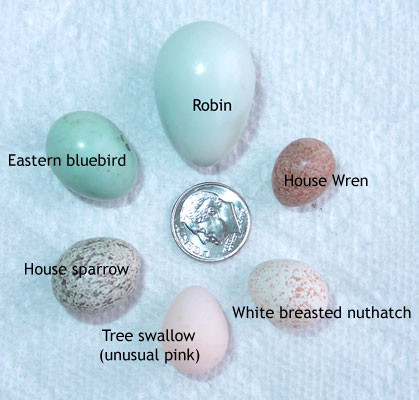
A tiny, blue egg. I found it along the trail at Fort Missoula, and have yet to get a confirmation of what kind of bird it belongs to! Of course, it is most probable that it was a robin's egg--but it was definitely no bigger than a quarter. Could it have belonged to someone else?
Here's a chart I found of the sizes of eggs (some of which are blue) from someone in Connecticut. An Eastern bluebird egg is the same size, approximately, as a Western or mountain bluebird.
European Starlings can also have blue eggs. Their eggs are darker and smaller than robins' eggs, a little larger than a bluebird egg, and glossy, but without any spotting. If you want to have a go at IDing the egg we saw, do so in the comments!
At Fort Missoula, kids ate their snacks all crammed into the big log. These girls were all telling each other about things they had seen, and it from a ways off it seemed like the log itself was chattering.
Some discoveries:
A tiny, blue egg. I found it along the trail at Fort Missoula, and have yet to get a confirmation of what kind of bird it belongs to! Of course, it is most probable that it was a robin's egg--but it was definitely no bigger than a quarter. Could it have belonged to someone else?
Here's a chart I found of the sizes of eggs (some of which are blue) from someone in Connecticut. An Eastern bluebird egg is the same size, approximately, as a Western or mountain bluebird.
![]() |
| http://www.sialis.org/nests.htm |
This group of kids at Council Groves enjoyed walking alone, and really loved skipping rocks along the river afterwards. They seemed so enthralled by being alone that I had to run around to gather them back togther to share their discoveries from the solo hike!
At Fort Missoula, kids ate their snacks all crammed into the big log. These girls were all telling each other about things they had seen, and it from a ways off it seemed like the log itself was chattering.
27 February 2012
Bitterroot Valley surprises.
So often, we tend to think of "natural history" in terms of the arguably more traditional definition of nature, specifically as the world surrounding humankind but existing independently of or uninfluenced by human activities.Certainly, this is a major part of natural history (the history outside of our own species), but it's so important to also include the history that involves our coexistence with and stewardship of the natural world.
The Big Ditch (more formally known as the Bitter Root Main Canal) has an impressive history. Copper King Marcus Daly first conceived of a giant canal when he moved to the Bitter Root Valley and founded Hamilton in 1887. He built a few irrigation projects in the area, but his plans for a "big ditch" along the length of the entire valley were ended by his death in 1900. That same year, though, an intrepid business man named Samuel Dinsmore joined the irrigation game, and made plans to build a pipeline and canal that took water from the west fork of the Bitterroot River and ran parallel the river to Hamilton. After a few years, when finances ran low, he attracted wealthy investors from Chicago to finance his project, and it was then he founded the Bitter Root Irrigation Company and added the plan to take water from a storage-worthy fortified Lake Como. The scheme included the grand idea to buy up cheap land, bring irrigation water to it all, and resell hundreds of "orchard plots" to out-of-towners for a hefty profit. So, the "Apple Boom" of Western Montana was launched into full gear. Hundreds of speculative land buyers came to partake in the supposed fruit cornucopia of the Bitterroot Valley. The Big Ditch was dug with massive steam shovels and communities were constructed, and the since-burned lavishly glamorous Bitter Root Inn was built. The promotional scheme seemed to be working.
While out on a side road that I had successfully found crossed the Big Ditch, I paused to take a photograph at a sweeping bend of the canal that held some water from both snow melt and a dripping pipe that funneled a creek across near the bridge. I was stunned when I heard the following sound, and then saw its creator:
Yes, that's right; the red-winged blackbirds are beginning to return; spring is imminent! (I believe the one I heard and saw was a bachelor or yearling red-winged blackbird, recognizable by its muted or orange shoulder patches. These young guys return to gather in bachelor flocks rather than stake out territory like older males. He was smaller and up in a tree, not down near an obvious nesting site along the canal.)
All in all, what a magnificent adventure. And what a wonderful reminder that our cultural history remains so intertwined with that of the natural world, that even the things that many may believe are a threat to the natural world (ie: agriculture) also (or rather) provide habitat for the creatures with which we coexist.
As the sun set in the Bitterroot Valley, and as I paralleled the last leg of the tapering Big Ditch, I saw a group of white-tailed deer pause in a dry grass-filled pasture. The clouds were painted pink in the sky above them, and for a moment they looked curiously toward me before lifting their fluffy tails and bounding away toward higher ground. Below us, the lights of the city of Stevensville twinkled. The Bitterroot Valley held so many lovely surprises.
| 2012 © Sara J. Call |
Which brings me to The Big Ditch. There is a large canal that begins at the corner of Lake Como and stretches up past Stevensville to the bench lands southeast of Florence, delivering water to agricultural land (over 1,300 users) along a span of 75 miles. It is 25 feet across at the Lake, and gradually dwindles to a third that size before petering out to transect ditches completely.
![]() |
| 2012 © Sara J. Call |
|
If you grew up in agricultural land as I did, you know that even though water only fills canals and ditches for a few months out of the year, they create a significant amount of riparian-type habitat. And even though they go in relatively straight lines and don't meander like streams and creeks we like to picnic alongside, they are home to many of the same creatures we know and love near other waterways.
But farmers found they could not afford to pay for water rights, and the land was not as perfectly suited for McIntosh apples as advertised. By 1917, the Bitter Root Valley Irrigation Company went bankrupt, and finally in 1920 the company became a municipal corporation run by the farmers that remained to raise livestock, vegetables, and wheat. Only a few orchards remain.
![]() |
2012 © Sara J. Call
|
But the ditch remains. There is no sign or historical plaque marking it. It is still fully operational. And it is impressive; from Lake Como, it is sent up on to a bench on the west edge of the valley, then, a few miles later, it goes into a massive pipe, off a steep hillside, and disappears under Highway 93. It reappears on the other side of the pavement and crosses over the Bitterroot River, where it threads across the valley and weaves along the bench lands paralleling the river along the Selway Range.
![]() |
| 2012 © Sara J. Call |
I managed to follow it and intersect the ditch every so often along its length. I took unpaved residential roads, followed the Skalkaho Pass road, got lost in rural neighborhoods following transect ditches up to their origins, and found myself amazed at the immensity--and beauty--of the irrigation project.
While out on a side road that I had successfully found crossed the Big Ditch, I paused to take a photograph at a sweeping bend of the canal that held some water from both snow melt and a dripping pipe that funneled a creek across near the bridge. I was stunned when I heard the following sound, and then saw its creator:
![]() |
| 2012 © Sara J. Call |
All in all, what a magnificent adventure. And what a wonderful reminder that our cultural history remains so intertwined with that of the natural world, that even the things that many may believe are a threat to the natural world (ie: agriculture) also (or rather) provide habitat for the creatures with which we coexist.
As the sun set in the Bitterroot Valley, and as I paralleled the last leg of the tapering Big Ditch, I saw a group of white-tailed deer pause in a dry grass-filled pasture. The clouds were painted pink in the sky above them, and for a moment they looked curiously toward me before lifting their fluffy tails and bounding away toward higher ground. Below us, the lights of the city of Stevensville twinkled. The Bitterroot Valley held so many lovely surprises.
| 2012 © Sara J. Call |
For further information:
23 February 2012
February in the Bitterroot.
Nearly a month ago, Bitterroot Bill (the yellow-bellied marmot, cousin to groundhog Punxsutawney Phil) predicted the imminence of spring--or, more accurately, he didn't show himself at all on the overcast Groundhog Day at the Lee Metcalf National Wildlife Refuge. That may be hard to believe with all the winter storm warnings we have been getting, but we can always hope.
There's quite a bit less snow in the Bitterroot Valley, and quite a bit more sun. I drive out there every so often to get out from under the grey skies that have been frequenting Missoula Valley as of late. Even when the sky is overcast in the Bitterroot, it will open up to let rays of sun burst through, which is always wonderful. Last week, I drove down through Stevensville and took a loop through the Lee Metcalf Refuge to catch those rays of sunlight. There's a surprising amount of bird-watching to be had along the ponds, even now. Before long, I'm sure one will be able to spot a muskrat or two patrolling the thawing waterways.
Briefly, some interesting history about Lee Metcalf National Wildlife Refuge: it was founded in 1963 and renamed to 'Lee Metcalf' in 1978 in honor of the late senator that helped establish conservation projects across the state of Montana. The refuge is a total of 2,800 acres. Natural trails wind through 160 acres of ponds, sloughs, and river bottoms. While it predominately caters to providing habitat for migratory birds, the refuge also contains plenty of other creatures: beavers, muskrats, osprey, and yellow-bellied marmots, to name a few. Fish are also protected residents. The habitat is actively managed, meaning that people control water levels using siphons and pumps; provide weed control using fire, mechanical means, and sometimes cattle; and allow sportsman to come birding during hunting season. All of the management techniques are necessary to help maintain healthy wetlands and riparian areas in the refuge, where the riparian zones are human-enhanced and dependent on periodic drawdowns.
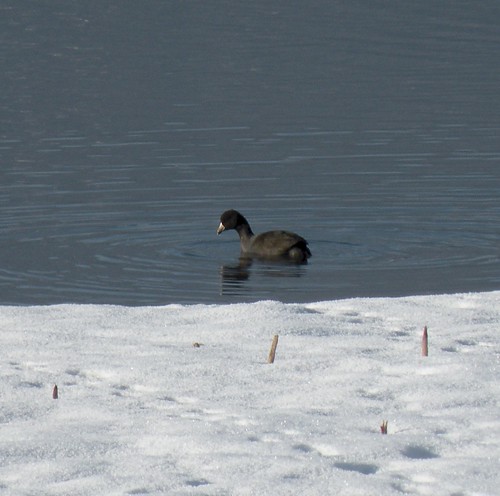
The Bitterroot Range provides a wondrous backdrop to the wetlands. I saw dozens of ducks (mallards and others) and Canada geese, and watched an American coot dabbling near the shoreline, tipping forward and bobbing with tail pointing skyward for a few moments before settling back upright on the water to swallow whatever he had found to eat.
A great blue heron stood reflected in a small pond as the sun set, and the clouds were splashed with an amazing array of pink and purple that we rarely see in Missoula skies. Before I could document the moment in a photo, the heron hunched his lanky frame and lifted away into the dusk, scattering droplets of water like beads.
In the coming months, the red-winged and yellow-headed blackbirds will return, which is my favorite time of spring. You can definitely bet on good birdwatching at Lee Metcalf NWR, year-round.
See our spring post on the birds of Lee Metcalf from last year here.
REFERENCES:
"Get Ready For Spring" - NBC Montana, 2 Feb 2012
"Lee Metcalf Refuge Revitalizes Pond with Fire, Cattle" - 4 Nov 2011
Montana Birding Trail - Lee Metcalf NWR
USFWS Lee Metcalf National Wildlife Refuge website
Wikipedia entry
![]() |
| © Sara J. Call 2012 |
![]() |
| © Sara J. Call 2012 |
Briefly, some interesting history about Lee Metcalf National Wildlife Refuge: it was founded in 1963 and renamed to 'Lee Metcalf' in 1978 in honor of the late senator that helped establish conservation projects across the state of Montana. The refuge is a total of 2,800 acres. Natural trails wind through 160 acres of ponds, sloughs, and river bottoms. While it predominately caters to providing habitat for migratory birds, the refuge also contains plenty of other creatures: beavers, muskrats, osprey, and yellow-bellied marmots, to name a few. Fish are also protected residents. The habitat is actively managed, meaning that people control water levels using siphons and pumps; provide weed control using fire, mechanical means, and sometimes cattle; and allow sportsman to come birding during hunting season. All of the management techniques are necessary to help maintain healthy wetlands and riparian areas in the refuge, where the riparian zones are human-enhanced and dependent on periodic drawdowns.
The Bitterroot Range provides a wondrous backdrop to the wetlands. I saw dozens of ducks (mallards and others) and Canada geese, and watched an American coot dabbling near the shoreline, tipping forward and bobbing with tail pointing skyward for a few moments before settling back upright on the water to swallow whatever he had found to eat.
![]() |
| © Sara J. Call 2012 |
![]() |
| © USFWS Mountain Prairie |
A great blue heron stood reflected in a small pond as the sun set, and the clouds were splashed with an amazing array of pink and purple that we rarely see in Missoula skies. Before I could document the moment in a photo, the heron hunched his lanky frame and lifted away into the dusk, scattering droplets of water like beads.
In the coming months, the red-winged and yellow-headed blackbirds will return, which is my favorite time of spring. You can definitely bet on good birdwatching at Lee Metcalf NWR, year-round.
See our spring post on the birds of Lee Metcalf from last year here.
REFERENCES:
"Get Ready For Spring" - NBC Montana, 2 Feb 2012
"Lee Metcalf Refuge Revitalizes Pond with Fire, Cattle" - 4 Nov 2011
Montana Birding Trail - Lee Metcalf NWR
USFWS Lee Metcalf National Wildlife Refuge website
Wikipedia entry
10 October 2011
Ninepipes National Wildlife Refuge
In the middle of September I had the chance to attend the Crown of the Continent Roundtable in Polson, and on my drive back to Missoula I thought I would take the opportunity to stop at the Ninepipes National Wildlife Refuge, just south of Ronan. I had driven past Ninepipes many times, but I always had somewhere to be, so it just never happened.
Ninepipes was created in 1921 as a refuge for native birds.. The refuge is located within the Flathead Reservation, but is maintained by the U.S. Fish and Wildlife department. According to the Fish and wildlife website, Ninepipes is home to avian species such as red-necked grebes, song sparrows, yellow headed and red winged blackbirds, ring necked pheasants, American bitterns, sora rails, osprey, great blue herons and double crested cormorants. Non-avian species such as muskrat, striped skunk, mink, badgers, field mice, meadow voles, porcupines, and the occasional grizzly bear call Ninepipes home.
There are no developed areas of the refuge, so on my visit I drove down a small an unassuming dirt road, just off of highway 93, to a dead end, parked my car, and found a walkway lined with informative signs. The path, while paved, showed signs of deterioration and plants were eager to root themselves in the cement cracks. The wide expanse of the refuge was beautiful, especially with the Mission Mountains looming to the east. Grasses swayed in the wind, duck calls rang across the water, and I was greeted with a slight fall sprinkling of rain. Despite being less than a mile from highway 93, civilization felt a world away. Since this stop was on a whim, I lacked binoculars and a bird book. I do recall seeing a few Mallard ducks and even a heron off in the distance, but there were many birds than I can identify.
If you find yourself on highway 93 with a few minutes to spare, I highly recommend stopping and enjoying the scenery yourself!
06 July 2011
July Observations - What Have You Been Seeing?
It's July, the weather is glorious, and summer is here! This is the time when lots of folks are getting outside, taking hikes, exploring the rivers, going on backpacking trips. Please share what you're seeing (and where you're finding it!).
Two weeks ago I went on an amble up Waterworks Hill and saw a family of mountain bluebirds:
The parents were feeding their little fledgling, who must have been just out of the nest:
western meadowlark
black-headed grosbeak
American goldfinch
black-billed magpie
northern flicker
warbler sp.
chipping sparrow
eastern kingbird
raven
western bluebird
house finch
red-breasted nuthatch
black-headed grosbeak
American goldfinch
black-billed magpie
northern flicker
warbler sp.
chipping sparrow
eastern kingbird
raven
western bluebird
house finch
red-breasted nuthatch
So--what are you finding, on your outdoor explorations?
We would love to hear about it!
Subscribe to:
Posts (Atom)