Showing posts with label Tom. Show all posts

09 February 2015

Traveling in the Backcountry: the essentials


A cold sweat chills me from under my backpack straps. The rhythm of my ascent up the clean white mountain side hypnotizes me. Slide-clack slide-clack. My skis cut a new climbing track up the wind-drifted slope. I climb up along a sub-ridge with a friend, past twisted sub-alpine fir trees barraged by wind since germination. It's a struggle to keep grins off our faces despite the steep grade and wind-hardened snow. It's a bluebird day in the Rocky Mountains and that is hard to beat.

Exploring backcountry terrain in winter is inherently risky, so there are a few things I bring along in my backpack and in my brain to try to minimize that risk or avoid it altogether.


  • Shovel - a light and sturdy aluminum shovel is absolutely essential for a good winter backcountry kit. Not only is it necessary for digging test pits to evaluate potential avalanche hazard, but shovels are great for digging out tent pads, fire pits, and are even great to sit on if you want to stay out of the snow. 
  • Cord - bringing a length of nylon cord (4-6 mm thick, at least 10 m long) is a great idea. It's a necessary part of proper test pit procedures, can be useful in rescue scenarios and has a host of other uses.
  • Probe - it is really important to continually check the depth of the snow pack you're traveling across. Probes are collapsible, graduated aluminum tubes that can be poked down through the snow to measure its depth. They are also essential for a successful rescue in the case of an avalanche burial.
  • Avalanche beacon - always be wearing your beacon and have it turned on from the time you leave the trailhead to the time you get back. Make sure every member of your party knows how to use their beacon, and make sure to practice with them (and the rest of your safety gear) before you get into potential avalanche terrain. Keep in mind: beacons will not guarantee your safety. Do not rely on them.
  • Small repair/survival kit - you never know when gear is going to malfunction. Bindings, boots, and snowshoes can break. Bringing a small bag with a multi-tool, knife, headlamp, extra batteries, ski scraper, lighter/matches, and thermal blanket can really be a life saver--especially if you're a worrier like me.
  • Avalanche forecast - always, always, always check the avalanche advisory from your local avalanche center before you decide where you're headed, or even whether you're going out at all.
  • Knowledge and common sense - the best way to survive an avalanche or exposure in the backcountry is not to get in a bad situation in the first place! Be up to speed on safe snow travel, route-picking, avalanche avoidance, and snow science, and know the area you're going to play in. If you've never been there before, go out with or talk to someone who has.
  • A Plan - make an itinerary for your day. Write down notes or thoughts after you read the advisory, map your route if you've never been there before. Record what you see while you're out for future reference. Let someone know about your plan back home. Talk about your plan while you're out with your partners. I have found that this helps me maximize my experience in the backcountry. I don't waste time deciding where to go, and it helps me make more confident safety decisions.


We crest the main ridge. We're entering the slope a few hundred feet east at a safe entry point that's not too wind drifted.Wind blows snow into our faces. One last safety check. Boots tight, bindings secure. I watch my friend descend onto the face, a sheltered slope still clinging to some good snow. He makes arcing turns as he paints a portrait of sheer bliss.

Butterflies fill my stomach and the sun-laden snow seems even brighter. He makes it down and signals for my descent from a safe location. One last check of the boots and I roll over the edge.

28 January 2015

Educating our Educators: equipping teachers with tools for place-based education

Being involved at the Montana Natural History Center has given me the unique opportunity to interact with a variety of people from across Montana. From preschool teachers to university professors, and from field scientists to young aspiring naturalists, there are two common and binding characteristics that I have observed: a strong sense of place and love of learning.

Last weekend wrapped up the final session of the 2014-2015 A Forest for Every Classroom (FFEC) program. This program is a collaboration between a host of government agencies, education non-profits, universities, and environmental organizations that provides place-based education training for educators. FFEC's mission states that it is "a dynamic professional development program for educators focused on place-based approaches to education. Teachers who participate in FFEC gain experience, form relationships and increase their own knowledge so that they are able to foster student understanding of and appreciation for their natural and human communities."


I am fortunate enough to have gotten to attend two of these sessions as MNHC's FFEC intern. Over days we spent in the pristine larch groves and snowy track-riddled forests of the Swan and Blackfoot Valleys, I canoed across fog-hooded lakes before sunrise, listened to stories about horsepacking through wilderness and toured active timber harvest sites. Our group also had the opportunity to experience the tribal material culture that is as much a living part of that landscape as the mink we tracked in and out of a frozen creek.


During my time with these teachers, I began to see something that goes unnoticed by many in America today. I saw a deep connection integrally tied to landscape and hardworking people who were trying to find the best ways to communicate that to young people of all ages. I saw kindergarten teachers learning how to integrate place-based education into play time and high school teachers learning how to integrate more out-of-classroom learning into their curriculum. I saw teachers from small rural schools interacting and networking with each other, sharing ideas and building friendships.

I think these educators, with their diverse backgrounds and personalities, embodied most what I truly appreciate about people: true empathy. Their commitment to providing young Montanans with quality leaning opportunities is wholly noble and undoubtedly supported by A Forest for Every Classroom.


07 February 2014

Friday Field Notes: Winter Gemütlichkeit

Photo: Ryan Milling
Now that Montana is back into the throes of Winter, I can postpone my pining for spring and enjoy the winter wonderland. I have not been able to look outside without being reminded of the things I truly love about the Northern Hemisphere being tilted away from the sun.

Snow is probably number 2 on my list of enjoyable frozen things (number 1, of course, occupied by ice cream). Snow affords us fantastic opportunities to enjoy nature. Skiing, sledding, snowshoeing, frolicking, track identifying, snowflake admiring...

The list goes on.

I usually like to share my experiences in wild snowy places and I always experience a distinct emotion that I feel the English language has no single word to describe. The Germans must have spent some serious time in the snowy Black Forest or Alps with their friends and loved ones to come up with this word: Gemütlichkeit. The word describes a sense of kinship and coziness but also a feeling of unhurriedness and sense of place.

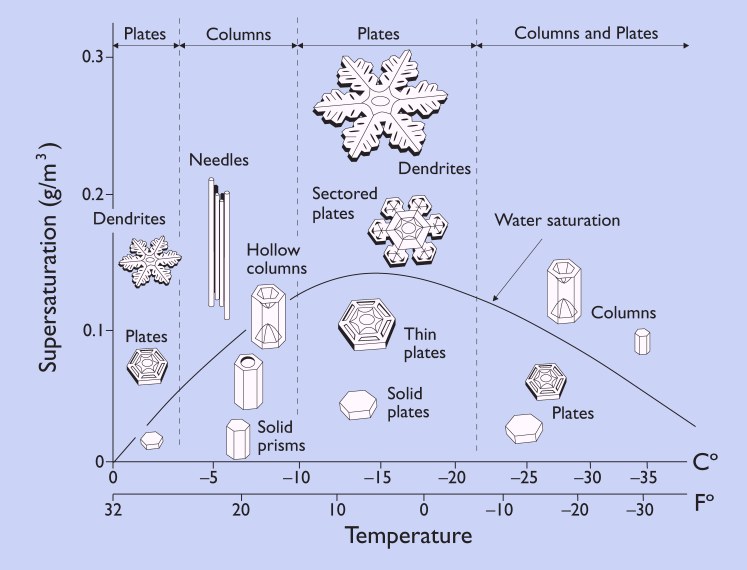
I wonder if my feeling of Gemütlichkeit this time of year is attributable to something intrinsic in snow. The birth of a snowflake takes place far above tree limbs and rooftops, their final resting places. Snowflakes form when cold water droplets crystallize around particles of pollen or dust in the atmosphere. As the ice crystals descend toward our sidewalks and ski slopes water vapor in the air crystallizes around them, forming familiar six-sided snowflakes.

The old adage goes "no two snowflakes are alike"--and that's pretty much true! The length of each arm of a snowflake is determined by its immediate environmental conditions (mainly temperature and moisture in the air: warmer/wetter = longer spindly flakes, colder/drier = shorter, more plate-like flakes). Each snowflake has minute differences in its immediate environment and so each one branches at a different point, or grows a different length, etc.
6-fold symmetry of ice crystals.

Snowflakes get their distinct 6-fold symmetry from the molecular structure of ice crystals, which is also a 6-fold symmetry. The ice crystals build on each other until the snowflake itself mirrors its molecular structure.

I suppose ultimately each individual snowflake is a collection (maybe even a companionship) of ice crystals, making a journey together towards the earth, and landing in just the right places for us to enjoy.

Photo: Ryan Milling

31 January 2014

Friday Field Notes: Chinook Winds of Fortune

On my ride into the Montana Natural History Center this morning there was one thing that was impossible not to think about: WIND. Struggling against a current of wind on an icy bike path is no cakewalk. Missoula doesn't get this windy too often, but just a handful of miles across the Continental Divide onto Montana's high plains, it's another story.

Most of Montana is occupied by rolling grasslands, once dominated by bison, pronghorn, and prairie dogs. Beautiful shortgrass prairie stretched from the flanks of the Rockies and moated the island ranges of the central and eastern parts of the state. The rich soils that sustained the plentiful life were also ideally suited for growing crops like wheat and alfalfa and stock grazing. A short time after the advent of white settlers, much of the prairie had been checkered with farms and fences, altering the pristine landscape into an anthropomorphized version of its former self.

Looking out from Square Butte towards the Missouri River Breaks
Weather, however, remains indifferent to our terrestrial tillings, not appearing to care about our comfort or chapped faces.

Wind has played an important role in Montana's history, particularly on the eastern slope of the Rockies. From harnessing wind for energy production, to dispersal of seeds and pollen for various plants, wind, despite its indifference, is critical for life on the prairie.

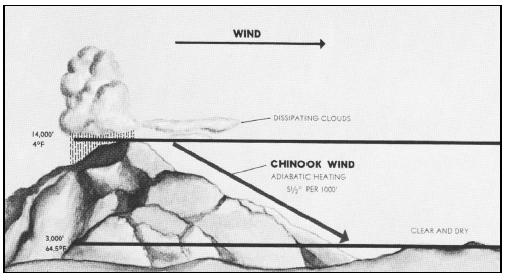
Chinook winds have certainly made their mark on Montana history. A Chinook wind a is warm, dry air mass that rips down the east slope of high mountains and warms the plains it crosses. Chinooks form from  westerly humid cells of air from the Pacific that dump their moisture on the west sides of mountain ranges (the great and mighty Rockies in our case), then warm adiabatically on their way back down the eastern side. The Chinook winds reach temperatures up to 60 degrees F and tear across that landscape at speeds up to 100 mph, melting and sublimating snow in their wake.
http://www.weatherexplained.com/images/walm_01_img0191.jpg
These winds are most common and severe from Cutbank to Helena, Montana. The high, steep eastern slopes of Glacier and the Bob Marshall and Scapegoat Wildernesses warm more quickly. The greatest temperature change in a 24-hour period in the U.S. was due to a Chinook wind, and occurred in Loma, Montana. The temperature went from -54 to 49 F, a 103-degree change! It is plain to see that ranchers would have relied on these remarkable weather events to make it through the unforgiving winters that punctuate every year in central Montana.

Waiting for a Chinook by Charlie Russell
As I bike back home today against that not-so-warm wind coming out of the mouth of Hellgate Canyon, I'll be dreaming of warm, dry Chinooks on the prairie.

24 January 2014

Friday Field Notes: Icy Sentinels: Stalwart Herons in Winter


Riding my bike in the summer along the Clark Fork River sometimes feels like an exhibition of nature. Munching beavers, darting kingfishers, and watchful Osprey are rarely out of sight or unheard. Trout break the surface of the river and grebes and their allies dip to catch a morsel under the cool water. But, as the warm clear mornings start to turn into cold ones and ice forms along the river's bank, only the hardiest animals show themselves.

A watchful eye in winter will turn up some of these unyielding creatures. One not too hard to spot is the Great Blue Heron. I was amazed to see that these large graceful birds were waiting at the edge of the ice, staring motionless into the water, as if mesmerized by the chunks of ice floating by. My thoughts then turned to a poem by renowned poet Mary Oliver--Herons in Winter in the Frozen Marsh.

http://writersalmanac.publicradio.org/index.php?date=2009/12/27

This poem captured much of the feeling I experience while watching these icy sentinels.

If you look carefully at some places on the river ice you can see their "pitchfork" footprints along the water's edge. You may be wondering how the herons can stand the cold with their long scaly legs in the frigid water or on the ice, and the answer is that they are equipped with a special routing of blood vessels in which the vessel carrying blood out to the leg lies directly against the vessel carrying blood back in. This is called "counter-current heat exchange," and is an adaptation used by many organisms across the globe. The blood going into the legs warms up the blood coming back into the body, keeping the heron's body temperature at a remarkable 103 to 106 degrees Fahrenheit (keep in mind that the average human body temperature is 98-99 degrees Fahrenheit). This allows them to stand at or in the water's edge and watch for fish and crustaceans for long periods of time.

As for me, I feel fortunate that I don't have to stand barefoot in the cold river to catch a bite to eat. I'm content just watching the pros at work.

So next time you find yourself along the river, make sure to scan for herons, motionless and cold, looking for lunch.
http://www.words4it.com/?tag=footprint