13 September 2013

Friday Field Notes: A Little Face on a Quaking Aspen Leaf


Last Friday, September 6th, I enjoyed a leisurely hike up to the Blodgett Canyon Overlook in the Bitterroot National Forest. The warm sun was muffled by a scattering of grayish clouds, allowing the temperature to stay below 85 degrees. It was a perfect day for a short adventure.

On the descent of the hike, I stopped next to a four-foot-high quaking aspen tree alongside the trail. I reached for a leaf, and placed it in my hand. My fingers followed the contours of its outline, amazed at its symmetry. I stepped back to look at the whole tree, when my fiancé said, "Hey, look at this!" Between his fingers he held another aspen leaf. I glanced at the leaf, but didn't notice anything, and looked back at him questioningly. He said, "Look closer." As I stared at the leaf, I was taken aback by the caterpillar that lay on the leaf before me. Two yellow ovals on the top of its head created the appearance of eyes, and a yellow and brown line across its thorax unveiled a smirk (depending on your perspective). Its green body with subtle blue dots blended in perfectly with the leaf.

I learned that this caterpillar was a Western Tiger Swallowtail, or Papilio rutulus, and that it is common to western North America. They are often seen in woodlands, riparian areas, and urban settings. These caterpillars feed on the leaves of hardwoods, such as poplar, willow, alder, maple, cottonwood, and quaking aspen. The Western Tiger Swallowtail caterpillar, or larva, will molt about five times before pupating (that is, evolving from a caterpillar to an adult insect--in this case, a butterfly). For butterflies, the pupal stage is called chrysalis. When the caterpillar has reached its full size, it produces silk to adhere itself to a leaf or limb of a tree. At this point in the process, the caterpillar will shed its skin one last time, leaving a hard skin, called a chrysalis. The caterpillar will stay in this stage until it is ready to turn into a butterfly.

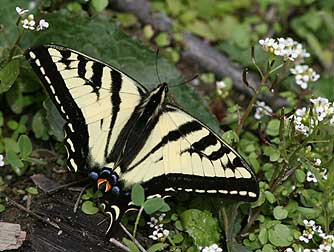
In the summer, a butterfly can emerge within fifteen days of pupating, but if it pupates in the fall, it must wait until springtime, when the temperature begins to rise. The beautiful butterfly that emerges from the chrysalis has yellow on its forewings, a thick black border along the wings' outside edge, and a hint of orange and blue on its tail. Its wingspan is ~8.5 centimeters. Females will lay up to 100 eggs onto the protective underside of leaves, and within four days or so, they will hatch, introducing a new group of smirking caterpillars into the natural world.
06 September 2013

Friday Field Notes: Sketching Changes in Nature

For me, the start of school marks change. In my own body, I notice a change in the pace at which I move. It is as though the lethargy induced by summer's heat slowly starts to leave my body, revealing a new zest and passion for exploring the outdoors. I know that I transform in this manner, because I listen to my body and I make note of the changes that I feel.

Similarly, if you take the time, you can note change in the natural world. As the seasons starts to change, so do the animals, birds, insects, plants, and natural landscapes. Change can be bold and impossible to miss, or it might be subtle and easily overlooked. In order to understand and learn from these changes, it is helpful to stop, observe, and document your observations about the way the natural world evolves. We can teach ourselves and each other about change, by tapping into our sense of sight, smell, hearing, and touch. The change of a season is a perfect time to start observing, sketching, and learning to embrace change.

How do you sketch changes?

Well, first start by creating or buying a nature journal. It does not have to be fancy, but it should include blank sheets of paper and be bound. Dedicate at least one page of your journal to each individual observation. Start by choosing a plant, animal, insect, bird, or landscape to sketch. If you choose a landscape, remember that it is best to start small. Date your entry, including the time, location, and weather. In your sketch, concentrate on details. You can add depth to your observation by including additional drawings, colors, and words.

 
Revisit the object or place on a daily or weekly basis. Make a new sketch on the same page as your first one. Note any changes in the new sketch in comparison to your last sketch. Remember to use all of your senses! Does is smell differently? Have the colors changed? Do you hear different sounds? Continue this process as long as possible. Be inquisitive and explore each curiosity to better understand the evolution of the object or place over time. Who knows, maybe you'll become fascinated with the changes, and you will have years and years of observations about one object or landscape. In the end, all of your observations, drawn and written, will help you and others to understand the complexities of change within our natural world. Go ahead, and start sketching changes in nature!


Learn how to make your own nature journal!

26 April 2013

Friday Field Notes: What's Blooming in Missoula?

By now, you must certainly feel like we've turned the corner here in western Montana and are well on our way to Spring. Sure, we've seen this before. Only a few weeks ago, temperatures were peaking in the 60s, and what did Mother Nature serve us up next? A week of rain and snow! But the weather these past few days, along with the forecast for highs in the 70s this weekend, has me convinced that Spring is here to stay. There's something else that has tipped me off, too . . . wildflowers!

For the past few weeks, since the very first buttercups defiantly sprung up from the ground, things have been slowly - but surely - progressing. Now, there are number of different wildflowers out and about that you should look for on your next hike. Here's a collection of what is in bloom around Missoula:

Shooting Stars on Waterworks Hill
Waterworks Hill:
On the lower slopes of Waterworks Hill, Arrow-leaf Balsamroot is beginning to dominate the south-facing fields, with some Biscuitroot and Larkspur joining the burst of color. Higher up the trail, Shooting stars and Yellowbells are abundant, while a few hearty Lupine are starting to flower. On the upper, wind-exposed ridge, Missoula White Phlox and Rocky Mountain Douglasia are abundant. There are also countless basal leaves of Bitterroots, but no flowers just yet. Below in Cherry Gulch, there are a few Woodland Stars to be found.

Mount Jumbo:
During a recent trail run along the lower slopes of Mount Jumbo, the most abundant flower appeared to be Buttercups. It was apparent that Yellowbells and Shooting Stars were already on their way out for the season, as the few that were found looked pretty worn. The next wave of flowers set to take over are Biscuitroot, Lupine, Arrow-leaf Balsamroot, and Larkspur, though only a handful of plants were actually in bloom. To my surprise, I found a number of Oregon Grape plants already flowering.

Arrow-leaf Balsamroot on Waterworks Hill

Rattlesnake Creek:
Along Rattlesnake Creek, the towering Ponderosa Pines have provided enough shade to slow Spring down quite a bit. The only flowers to be found in bloom were Buttercups. On some of the hills above the creek, a few Glacier Lilies provided a welcome surprise. Other than that, things appear to be a few weeks behind where they were last year. This may not really be related to wildflowers, but I'm sad to report that I have yet to find morel mushrooms in the areas I discovered them last year. Hopefully, the warm weather of late will be more conducive to wild mushroom foraging!


Rocky Mountain Douglasia on Waterworks Hill.

Oh, and since I've already strayed away from wildflowers with my mushroom rant, here's a killdeer nest:

Killdeer Nest in the Upper Rattlesnake.
We would love to hear about your wildflower observations or any other Spring happenings you've come across in the comments!

19 April 2013

Friday Field Notes: Spring Break Edition

Note: Two weeks ago, like many others around the state, I took the opportunity to get away from Montana's moody spring weather and head out on a Spring Break adventure to warmer climes. Each year, I am drawn by some invisible force to Utah's red rock country, and that is precisely where I landed yet again.  My home will always be amongst the mountains of the Northern Rockies, but the desert offers a type of experience that drives my imagination wild. For anyone with a remote interest in natural history, desert ecology and geology is truly fascinating. Of course, the landscape is also highly photogenic, its bizarre colors and sleek curves a dramatic contrast to the rolling mountains and valleys of Montana. The following are a handful of photos from my recent trip through Utah's Grand Staircase-Escalante National Monument. I hope they inspire you, excite your senses, and conjure up the adventure spirit found within all of us. - Mike Canetta


Fifty-Mile Mountain, a distinct "step" in the southwest's unique geologic formation known as "The Grand Staircase," is an ever-present feature near the town of Escalante.


Over eons, a large, abrupt bend in the river has carved a stunning amphitheater in Coyote Gulch.

(More photos after the jump)

29 March 2013

Friday Field Notes: Bluebird Days

Lately, it seems as if the sky is blue more often than not. There is nothing quite like waking up to a brisk, bluebird day in the spring in Montana. The growing strength of the sunshine warms the skin and raises hope that summer is not far away. But it isn't just the sun that illuminates the landscape this time of year.

On a recent outing up Missoula's Waterworks Hill, I heard a soft, chattery whistle sound. Initially, I was caught off-guard, but rather quickly it hit me: Mountain Bluebirds. I panned around, searching for the magnificent cerulean birds, and sure enough, there they were perched on a power line right above me. I don't know why I was so surprised to see them; the sweeping grasslands are perfect bluebird habitat that the birds return to every year. Perhaps it was simply the abruptness with which they arrived. The previous day, there were no bluebirds to be found. Now, there were dozens.
A male Mountain Bluebird with his lunch.
Mountain Bluebirds (Sialia currocoides) are a small member of the thrush family, which includes common birds like the American Robbin, Hermit Thrush, Townsend's Solitaire, and other bluebirds. While common throughout Montana and most of the interior West in the spring and summer, Mountain Bluebirds move as far south as Central America to winter. Rather interestingly, Mountain Bluebirds can tolerate colder habitats than other bluebirds, and some migrate westward to the Sierras for the winter. I suppose they must be pretty hearty, as their early return to the Northern Rockies inevitably results in them being forced to weather a handful of spring snowstorms.

Unlike many bird species, Mountain Bluebirds have largely benefited from human settlement and activity in the West. The clearing of previously forested lands and the expansion of agricultural development has opened up millions of acres of new bluebird habitat. They also have been helped by our affinity for them - there must be hundreds of thousands of "bluebird boxes" scattered across the western United States.

A female Mountain Bluebird hovers while searching for insects.
Like most thrushes, Mountain Bluebirds feed primarily on insects, although their diet is supplemented throughout the year with small fruits and seeds. What sets this particular bird apart from its close relatives, however, is the way in which they sometimes acquire their food. Mountain Bluebirds can often be seen hovering in place, not unlike American Kestrels, as they scan the ground for insects. If prey is found, they quickly swoop down to the ground like a raptor pouncing on a small rodent. It is a spectacular sight to behold, made all the wilder and more intense by the bird's stunning colors.

Over the coming days and weeks, more and more of these magnificent birds are sure to arrive. Their presence on Waterworks Hill and other grassy fields across Montana is likely to be accompanied by that of a close rival, the Western Bluebird. As mating season takes off and the struggle to establish a territory reaches fever pitch, Mountain Bluebirds will clash with Westerns as well as members of their own species over nesting boxes and territories. It will be a spectacle, no doubt. I, for one, will be watching eagerly.

Have you seen any bluebirds yet this spring? Do your bluebird boxes have new residents? Be sure to let us know in the comments!

19 March 2013

Friday Field Notes: Sounds of Spring

There are few better harbingers of spring in North America than the millions of birds that begin to arrive and sing about this time each year. Sure, an arbitrary date on the Julian calendar and the act of changing our clocks alerts us to the coming season, but nothing signals the actual arrival of spring and its warmer weather quite like birds and their songs do. And much to my delight,  all kinds of birds are beginning to "spring" up around Montana.

The first sign for me that migration was underway occurred about ten days ago, when I awoke to the sound of an emphatic Killdeer in my yard. Although these shorebirds are year-round residents of western Montana's valley bottoms, this particular pair seems to take off for greener pastures every year in late September, only to return to the same exact spot sometime in March. It was a surprising but welcome event.

One of my squatters on his first day back.
Not long after this punctual plover showed up, I noticed that there was a sudden influx of robins in the area. Like Killdeer, the American Robin is also a year-round resident, but only a handful stick around and brave the winter. Come late February/early March, large flocks of these renowned "early birds" begin to invade. It is safe to say that our lawns and parks will be worm-free any day now.

The surest sign of spring I've received thus far came only a week ago. At the crack of dawn, a Song Sparrow who managed to spend all winter in my backyard began singing his complex, melodic song in an attempt to impress a nearby female. His choruses were joined by dozens of hopeful Black-Capped Chickadees belting our their unmistakable "cheese-bur-ger" song. Then, out of nowhere, I noticed a Spotted Towhee vigorously scratching through leaves and dirt, likely searching for a suitable place to nest.

There have also been a few oddities that have signaled change is in the air. That same day, a small flock of Pine Grosbeaks joined the raucous group of birds around my home, likely beginning their trip up to the higher elevations where they breed. Even more shocking was the sight of a Mountain Chickadee on my feeder and a Townsend's Solitaire taking a bath in my gutter, sure indications that birds are moving around and transitioning from winter to summer habitat.

All of this recent bird activity around my home in Missoula coincides with the wealth of observations from around the state of Red-winged Blackbirds beginning to sing and court. It is only a matter of time, really, until Western Meadowlarks arrive and grace us with their bubbly verses. I'll really be a believer, though, when Mountain Bluebirds return to paint our hillsides the color of the sky. 

What's going on in your backyard? We'd love to hear from you in the comments!

01 March 2013

Friday Field Notes: A Bohemian Rhapsody


I see a little silhuetto of a bird,
It's got a crest! It's got a crest!
And a beautiful masked face!
... And waxy yellow tips on its wings?

I'll admit it: that was cheesy, at best. But the timing of this this naturalist-inspired Queen spoof is perhaps perfect. As winter crawls along, thousands of Bohemian Waxwings fill the valleys of western Montana with their sweet trill. Yet not every winter presents such a great opportunity to see them (indeed, their name "Bohemian" lends credence to their extremely nomadic nature), so it's worth taking advantage of the recent influx of these magnificent birds while they're here.

Bohemian Waxwings (Bombycilla garrulus) are one of three large passerine species that belong to family "Bombycillidae," commonly known as the Waxwings. The other two - Cedar Waxwings and Japanese Waxwings (native to Japan - surprised?) - are very similar in appearance to the Bohemian. Bohemian Waxwings (like their close cousins) inhabit temperate coniferous and mixed forests, and feed primarily on fleshy fruits and berries, though gleaning for insects becomes a primary summer feeding behavior. Interestingly, Bohemian Waxwings do not establish breeding territories, likely because the fruits they depend on are abundant during breeding season. As a result, these birds have no true songs, communicating almost entirely through their high-pitched trill.

While Cedar Waxwings are found in Montana year-round, Bohemians - outside of a small sliver in the northwestern-most corner of the state - only occur in winter. Thus, Bohemian Waxwings and Cedar Waxwings are both present in winter in Montana, and the two species frequently form mixed flocks. Hence, the problem: How does one tell apart these two extremely similar birds?

Cedar Waxwing top right; lower two birds are Bohemian Waxwings.
This photo, courtesy of the Cornell Lab of Ornithology, provides a big helping hand. The difference in size (Bohemian Waxwings on average are 2-3 centimeters longer and 1 ounce larger) is particularly noticeable, and other field marks become evident. Note the dark red coloration underneath the Bohemians' tails, which the Cedar Waxwing completely lacks. The best field mark to check for, however, is the belly color. Bohemian Waxwings have slate grey bellies, while Cedar Waxwings have vibrant, sulphur-yellow bellies that turn to amber nearer the head. Being able to pick up on this field mark will help you make a correct identification next time you're out and about with your binoculars.

Of course, you aren't very likely to get this good of a look at the two species side-by-side, as they are notorious for their constant gleaning and fluttering about. This is where being able to tell the difference in their call can be useful.  As you listen to the Bohemian Waxwing's high-pitched trill (http://www.allaboutbirds.org/guide/bohemian_waxwing/sounds), be sure to listen carefully, as you can hear each individual note in the call. Cedar Waxwings, by comparison, have a nasally, high-pitched whistle (http://www.allaboutbirds.org/guide/Cedar_Waxwing/sounds) which resembles more of a single "bzeeee" note. While at first the two calls sound very similar, you will quickly pick up on the subtle differences between the two.

Hopefully this crash course in waxwing identification helps you in your future birding pursuits. At the very least, you now know that Queen's "Bohemian Rhapsody" can be laughably re-mixed to accommodate birds and natural history topics!

Have you seen or heard any Bohemian Waxwings this winter? Be sure to let us know!