
Showing posts with label snow. Show all posts
Showing posts with label snow. Show all posts
12 February 2014


09 February 2014
Outdoor Explorations: Rattlesnake Ski Day
Winter has returned to western Montana, and we snow-lovers are thrilled. To many of us, to wake up to 6" of new, fluffy snow means one thing on a fine weekend day: we have to get out into it. My husband and I donned our layers and, armed with chocolate, water, a thermos of tea, and several eggy-avocado-y burritos, headed up to the Rattlesnake Recreation Area, where the parking lot was almost full and the snow was still falling. Two weeks ago the main trail was a sheet of ice, only ideal if one's goal was broken bones or bruises . . . but a foot of snow later, all is transformed.
 |
| photo by Allison De Jong |
 |
| photo by Allison De Jong |
 |
| photo by Allison De Jong |
 |
| photo by Allison De Jong |
 |
| photo by Allison De Jong |
 |
| photo by Allison De Jong |
What are your favorite winter activities? Where do you love to go to see wintry beauty at its finest?
07 February 2014
Friday Field Notes: Winter Gemütlichkeit
 |
| Photo: Ryan Milling |
Snow is probably number 2 on my list of enjoyable frozen things (number 1, of course, occupied by ice cream). Snow affords us fantastic opportunities to enjoy nature. Skiing, sledding, snowshoeing, frolicking, track identifying, snowflake admiring...
The list goes on.
I usually like to share my experiences in wild snowy places and I always experience a distinct emotion that I feel the English language has no single word to describe. The Germans must have spent some serious time in the snowy Black Forest or Alps with their friends and loved ones to come up with this word: Gemütlichkeit. The word describes a sense of kinship and coziness but also a feeling of unhurriedness and sense of place.
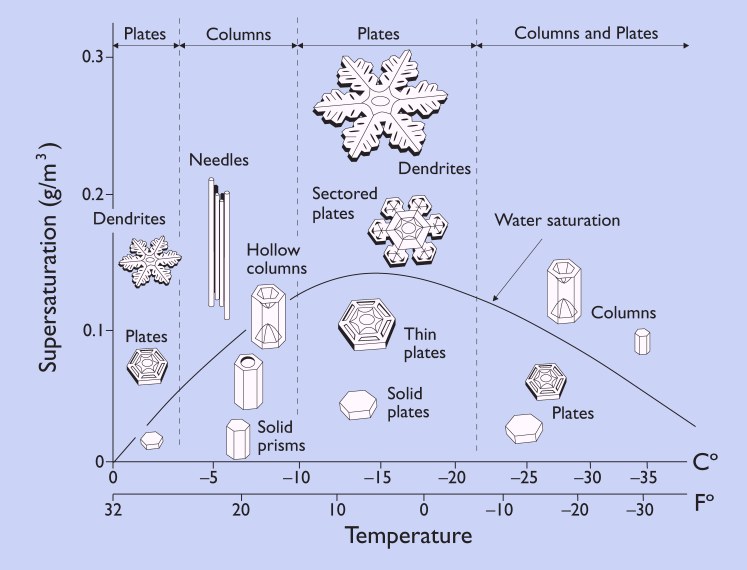
The old adage goes "no two snowflakes are alike"--and that's pretty much true! The length of each arm of a snowflake is determined by its immediate environmental conditions (mainly temperature and moisture in the air: warmer/wetter = longer spindly flakes, colder/drier = shorter, more plate-like flakes). Each snowflake has minute differences in its immediate environment and so each one branches at a different point, or grows a different length, etc.
 |
| 6-fold symmetry of ice crystals. |
Snowflakes get their distinct 6-fold symmetry from the molecular structure of ice crystals, which is also a 6-fold symmetry. The ice crystals build on each other until the snowflake itself mirrors its molecular structure.
I suppose ultimately each individual snowflake is a collection (maybe even a companionship) of ice crystals, making a journey together towards the earth, and landing in just the right places for us to enjoy.
.jpeg) |
| Photo: Ryan Milling |
07 December 2012
Friday Field Notes: Winter's Other World
There's a whole other world out there that only exists in winter. The arrival of snow literally creates an entirely new habitat not found at any other time of the year. Naturalists know this place as the "subnivean environment."
While we might just see snow as powdery white stuff that accumulates as winter goes on, there is actually a lot happening underneath the surface. And indeed, the word subnivean, which means "under the snow" in Latin, suggests just that. As snow accumulates, it undergoes a variety of transformations: it compacts, melts, and refreezes. All of these changes form what we commonly think of as the snowpack. The snowpack can contain a variety of different layers, some hard, some soft, some deep, some shallow. These layers provide opportunities for small animals to create burrows, tunnels, and other structures that would be much more difficult to maintain in the soil, which is typically frozen throughout the winter.
Small mammals, like mice, voles, and shrews, likely could not survive outside of the subnivean environment. In addition to providing physical space for them to live in, the subnivean provides critical insulation. While the world above the surface is exposed to high winds and temperatures in the negatives, life underneath the snow remains a relatively cozy 32 degrees Fahrenheit! The other benefit of living in the snowpack is the protection it offers from predators.
Of course, these small mammals aren't totally safe. Have you ever seen this?
Foxes - as well as coyotes and some owls - are capable of hearing the movement of rodents underneath the snow. They wait patiently, honing in to the animals' exact location. And then, they pounce (or in the case of the owl, swoop). Extraordinary, no?
American Martens, like most other weasels, have never been afraid of digging in and getting a little dirty (or snowy?). Instead of listening for rodent movement and using stealth to catch their prey, they rely on power and speed to ramble through the snow and grab critters.
While we might just see snow as powdery white stuff that accumulates as winter goes on, there is actually a lot happening underneath the surface. And indeed, the word subnivean, which means "under the snow" in Latin, suggests just that. As snow accumulates, it undergoes a variety of transformations: it compacts, melts, and refreezes. All of these changes form what we commonly think of as the snowpack. The snowpack can contain a variety of different layers, some hard, some soft, some deep, some shallow. These layers provide opportunities for small animals to create burrows, tunnels, and other structures that would be much more difficult to maintain in the soil, which is typically frozen throughout the winter.
Small mammals, like mice, voles, and shrews, likely could not survive outside of the subnivean environment. In addition to providing physical space for them to live in, the subnivean provides critical insulation. While the world above the surface is exposed to high winds and temperatures in the negatives, life underneath the snow remains a relatively cozy 32 degrees Fahrenheit! The other benefit of living in the snowpack is the protection it offers from predators.
Of course, these small mammals aren't totally safe. Have you ever seen this?
 |
| A fox dives into dinner head-first. |
Foxes - as well as coyotes and some owls - are capable of hearing the movement of rodents underneath the snow. They wait patiently, honing in to the animals' exact location. And then, they pounce (or in the case of the owl, swoop). Extraordinary, no?
And then of course, there's this:
 |
| A marten emerges empty handed. |
Next time you're out skiing or snowshoeing, imagine all the things that are going on beneath your feet! The snow isn't just snow; it's another world.
Subscribe to:
Posts (Atom)