Showing posts with label Butterflies. Show all posts

12 September 2014

Guest Post: Mystery Butterfly

Observations & photos submitted by naturalist Kim Birck, late July 2014.

Yesterday a butterfly I’d never seen before visited my yard. It had the colors of a swallowtail, but no tails, and it didn’t match anything I could find by doing a Google image search for “black and yellow butterflies." So I posted a (low-resolution) smartphone photo to Facebook and got an immediate reply from a cousin in Wisconsin--“Could it be a Mourning Cloak?” Though the Mourning Cloak is Montana’s state butterfly and does frequent my yard--and its general morphology is somewhat similar--I’d already ruled out Mourning Cloak using the eNature.com online butterfly field guide.  

However, eNature was no help in figuring out who the mystery visitor actually was. The categories I might have chosen from their list--swallowtails or “boldly patterned”--produced no results. This was a very cooperative butterfly, however, hanging around all day and posing prettily on the bee balms (Mondarda sp.) that have proliferated where the native vegetation catches overspray from the lawn sprinklers. So I was able to get several good shots with a real camera, and e-mailed one to my friendly local naturalist at the Montana Natural History Center, Brian Williams. 


Twelve hours later, I had a reply: “Hi Kim, Great picture and good butterfly--it's a female Great Spangled Fritillary. Charles [Miller] and I were out in the Rattlesnake yesterday and saw one ourselves! Perfect timing on your question too, I've been working on my fritillary ID skills the last two weeks.” 

I Googled Great Spangled Fritillary, and on the Wikipedia page found the reason why it was so hard to identify: “Females tend to be darker than males and individuals from the western reaches of this species range tend to be brighter orange.” Talk about an understatement! All the Great Spangled Fritillary images I’d ever seen were brown and gold. Who knew the sexes were practically dimorphic? Today, a couple orange-colored males were chasing each other around the yard, and one landed on the same flower as the female I was photographing. She took off, but here’s the male.


He appears a bit the worse for wear as the markings have faded, near his wingtips, especially. 

Here are views of the undersides of their wings: Male:


and Female:
 

After seeing them fluttering around, I had a few more questions for Brian: 

"How do you distinguish Great Spangled from the OTHER Fritillaries? Could GSF be easily confused with the Northwestern Fritillary?" 

He responded: "Well, identifying the fritillaries besides Great Spangled is my summer's million-dollar question. Luckily, the Great Spangled is the one (of 10 or so, it seems), that is most readily identified. The best characteristic is the nature of the silver spots on the bottom of the hindwing--in the Great Spangled, the spots are relatively few, small, and well-spaced compared to all the rest of the fritillaries (like your photo, which is indeed a Great Spangled). The Great Spangled is also a bit bigger than all the other fritillaries. So, while at first glance, the Northwestern and Hydaspe Fritillaries are similar to Great Spangled in overall color, it is possible to distinguish them in the field. Beyond Great Spangled, the question is much more muddied. Charles and I have been collecting fritillaries for a display and I've actually been submitting photos of our pinned specimens to the website 'Butterflies and Moths of North America' to get positive identifications. Good fun!"

(Now we know what naturalists do when they aren't leading field trips!) 

Natural History Information from the Butterflies and Moths of North America Website: 
Great Spangled Fritillary 
Speyeria cybele (Fabricius, 1775) 
Family: Nymphalidae 
Subfamily: Heliconiinae 
Identification: Large. Upperside of male tan to orange with black scales on forewing veins; female tawny, darker than male. Underside of hindwing with wide pale submarginal band and large silver spots. 
Wing Span: 2 1/2 - 4 inches (6.3 - 10.1 cm).
Life History: Males patrol open areas for females. Eggs are laid in late summer on or near host violets. Newly-hatched caterpillars do not feed, but overwinter until spring, when they eat young violet leaves. 
Flight: One brood from mid-June to mid-September. 
Caterpillar Hosts: Various violet species (Viola). 
Adult Food: Nectar from many species of flowers including milkweeds, thistles, ironweed, dogbane, mountain laurel, verbena, vetch, bergamot, red clover, joe-pye weed, and purple coneflower. 
Habitat: Open, moist places including fields, valleys, pastures, right-of-ways, meadows, open woodland, prairies. 
Range: Alberta east to Nova Scotia, south to central California, New Mexico, central Arkansas, and northern Georgia. 
Comments: The most common fritillary throughout most of the eastern United States. 

13 September 2013

Friday Field Notes: A Little Face on a Quaking Aspen Leaf


Last Friday, September 6th, I enjoyed a leisurely hike up to the Blodgett Canyon Overlook in the Bitterroot National Forest. The warm sun was muffled by a scattering of grayish clouds, allowing the temperature to stay below 85 degrees. It was a perfect day for a short adventure.

On the descent of the hike, I stopped next to a four-foot-high quaking aspen tree alongside the trail. I reached for a leaf, and placed it in my hand. My fingers followed the contours of its outline, amazed at its symmetry. I stepped back to look at the whole tree, when my fiancé said, "Hey, look at this!" Between his fingers he held another aspen leaf. I glanced at the leaf, but didn't notice anything, and looked back at him questioningly. He said, "Look closer." As I stared at the leaf, I was taken aback by the caterpillar that lay on the leaf before me. Two yellow ovals on the top of its head created the appearance of eyes, and a yellow and brown line across its thorax unveiled a smirk (depending on your perspective). Its green body with subtle blue dots blended in perfectly with the leaf.

I learned that this caterpillar was a Western Tiger Swallowtail, or Papilio rutulus, and that it is common to western North America. They are often seen in woodlands, riparian areas, and urban settings. These caterpillars feed on the leaves of hardwoods, such as poplar, willow, alder, maple, cottonwood, and quaking aspen. The Western Tiger Swallowtail caterpillar, or larva, will molt about five times before pupating (that is, evolving from a caterpillar to an adult insect--in this case, a butterfly). For butterflies, the pupal stage is called chrysalis. When the caterpillar has reached its full size, it produces silk to adhere itself to a leaf or limb of a tree. At this point in the process, the caterpillar will shed its skin one last time, leaving a hard skin, called a chrysalis. The caterpillar will stay in this stage until it is ready to turn into a butterfly.

In the summer, a butterfly can emerge within fifteen days of pupating, but if it pupates in the fall, it must wait until springtime, when the temperature begins to rise. The beautiful butterfly that emerges from the chrysalis has yellow on its forewings, a thick black border along the wings' outside edge, and a hint of orange and blue on its tail. Its wingspan is ~8.5 centimeters. Females will lay up to 100 eggs onto the protective underside of leaves, and within four days or so, they will hatch, introducing a new group of smirking caterpillars into the natural world.

22 October 2010

Spotlight On...Rubber Rabbitbrush

Rubber Rabbitbrush
Chrysothamnus nauseosus
Asteraceae (Sunflower Family)
Quick ID:  
In general, Rabbitbrush appears similar to Big Sagebrush--a scrubby shrub with grayish-tinged, woolly leaves.  Like sagebrush, it's found in dry, open plains or disturbed sites, and grows about 1 to 6 feet high.  The leaves are linear and alternate on flexible stems.  The yellow flowers bloom late (August-October), blanketing the plains and slopes with the type of brilliant display most flora exhausted months ago.  Being in the Asteraceae family, each flower is actually a loose cluster of mini-blooms known as "disc flowers", like the ones in the eye of a sunflower or daisy.  The "ray flowers" that we know as petals in other Asteraceae species are absent in Rabbitbrush.  
Range:
Found up to 10,000', from Canada to Mexico, east of the Pacific mountain system and stretching to the Great Plains.  Look for it growing near dryland bunchgrasses and shrubs like Big Sagebrush (Artemesia tridentata), Basin Wildrye (Leymus cinereus), Mountain Mahogany (Cercocarpus ledifolius) and Bluebunch Wheatgrass (Pseudoregenaria spicata).
What's in a Name?
A quick note on taxonomy:
It's the most fickle sport among scientists, always in flux and impossible to keep up on.  It's not so easy to remember all this archaic Latin binomial nomenclature, and once you think you've got it down, a new taxonomical relationship is discovered or refuted, groups are shuffled around, and the 15 syllable name you've been proudly slipping into casual conversation and engraving onto your garden signs is now obsolete.  So if you're the type to stick with what you know and ignore all the newfangled monikers, I, for one, won't judge you.
That said, Rubber Rabbitbrush is technically known as "Ericameria nauseosa (Pallas ex Pursh) G.L. Nesom & Baird", but in my heart of hearts, it will always be Chrysothamnus.  Chryso- means gold, -thamnus a thicket.  The "nauseous" root in the specific epithet is in reference to the strong smell the plant gives off, rather than the idea that ingesting it will make you sick.  In fact, the plant's thick latex has been used for centuries as a sort of chewing gum (hence the "Rubber" part).  It provides shelter for and is eaten by rabbits and other small mammals.
In some southern parts of the country, Rabbitbrush is known almost exclusively as Chamisa, from the Spanish word for brush or kindling, and ultimately derived from the Latin chama (-->flamma-->"flame").        
Tidbits:
The presence of Rabbitbrush, which often grows on very poor soils, and is considered a useful indicator that land is eroded or overgrazed.  It can be an important winter forage for antelope, mule deer and elk on depleted rangelands, but is sometimes reported to be toxic to livestock.
The plant has a few adaptations that allow it to thrive in arid, inhospitable places.  It's tolerant to a wide range of soil types, alkalinity, salinity, cold and drought.  The felt-like fuzz covering the stems (technically known as trichomes) acts as insulation and reduces water loss.  The light gray stems also reflect more heat than dark green leaves would, keeping the shrubs cool as a cuke in the harsh summer sun of the open prairie.
Historically, Rabbitbrush has been used to make yellow or green dye, and prepared as a tea to help coughs and colds.  The flexible twigs are good for baskets, and the seeds can be ground and used much like cornmeal.  
People have been looking for a way to use the natural latex found in the roots and inner bark to produce rubber since the 1930s, but haven't found a commercially viable way to extract it.  There is currently an investigation underway by the University of Nevada, looking at the potential of Rabbitbrush as a multi-use industrial crop for biomaterial and bioenergy applications.  Here's the interesting project summary.

Wild Gardening:  Plants need about 4' of space, and take about 4 years to mature.  They tend to produce about a million branches, generally arising from a common point and not overtaking neighbor plants.  Overwatering or fertilizing can produce leggy, sprawling plants.  New plants sprout up from the roots and can be divided, and the seeds germinate easily.
Being a late bloomer, Rabbitbrush fills an important niche both as an ornamental perennial and a fall pollen source for bees, flies and butterflies.  To see this plant in late fall, spilling over with brilliant color and buzzing with hundreds of hungry and deprived insects, is really incredible.  It tolerates fussing-over, but seems to delight in neglect: no extra water, no soil amendments, no pruning or deadheading.  The soft, pale branches complement the muted palette of a xeric landscape perfectly, and provide a safe haven for nesting birds and other small animals.


    Spotlight On... features Montana native plants that are currently on display in our natural areas.  Have a plant that you'd like to see featured?  Let us know!

28 April 2010

Spotlight On...Boxelder Maple

Boxelder Maple
Acer negundo
Aceraceae (Maple Family)
Quick ID:  
A relatively short (~30-50') tree, usually with multiple trunks, growing in moist woods and along streambanks.  The Boxelder is the only maple in North America whose leaves are compound (divided into parts - in this case usually 3). 
Acer negundo is dioecious (from the Latin "two houses") meaning the individual trees are distinctly male or female.  This is easy to distinguish in early spring when they're flowering:
                                                          Female pistillate flowers

                                                       Male staminate flowers

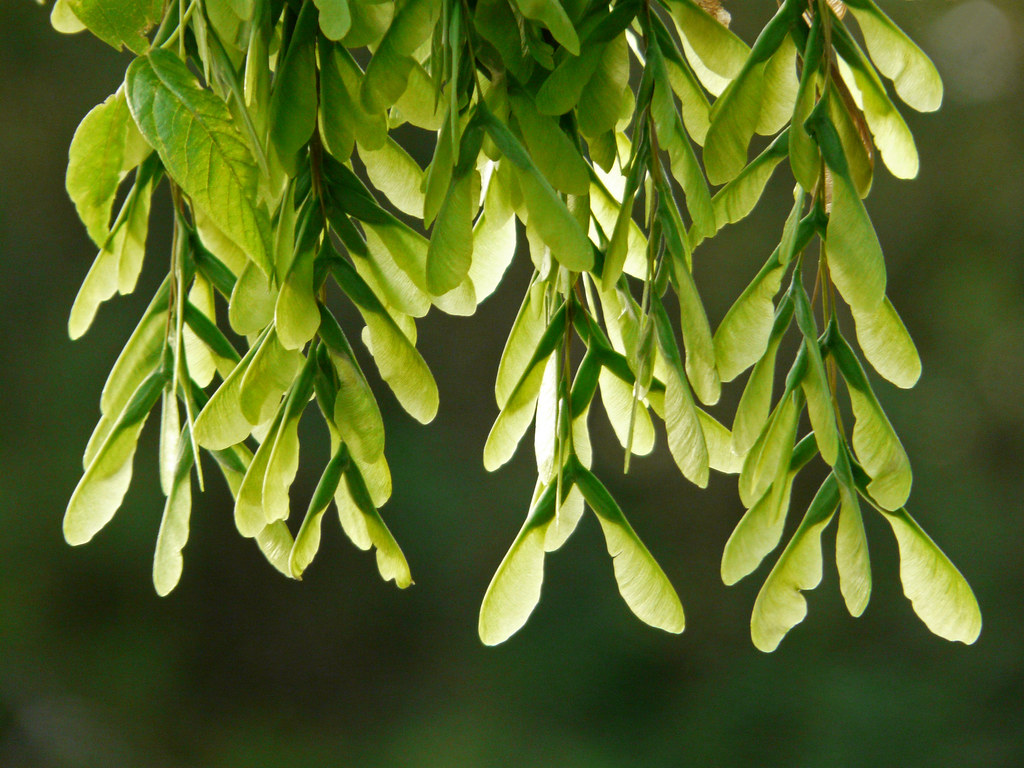
Only the female trees make the "helicopter" fruits common to maples (technically known as samaras, also called keys), and only if there is a male nearby. 
In winter, they're easy to recognize by their chubby, opposite buds; the twigs are fresh looking, green or purple, and covered with a fine fuzz that's easy to rub off.
The wood is abnormally soft for a Maple, and branches tend to break off easily, making this a somewhat scraggly tree.
Range:
The most widespread maple in the world, stretching from Ontario south to Guatemala, with a native range that covers a wide swath of North America.  In many parts of the US, especially eastern states,  it's considered a pesky tree at best; in Australia it's officially considered an invasive species.
What's in a Name?  
Acer means "sharp", in reference to the normally hard wood of maples, which the Romans used for spear shafts.  Negundo is a Sanskrit word referencing the resemblance to Chastetree (Vitex negundo).  The name Boxelder (or Box Elder) comes from the leaves' similarity to Sambucus (Elder) and the white wood's likeness to Boxwood (Buxus sempervirens).  A few sources say it's named for the fact that people make boxes from its soft wood, but I'm not buying it.  
This is also commonly known as Manitoba or Ash-leaf Maple.  In Spanish it's Fresno de Guajuco.   
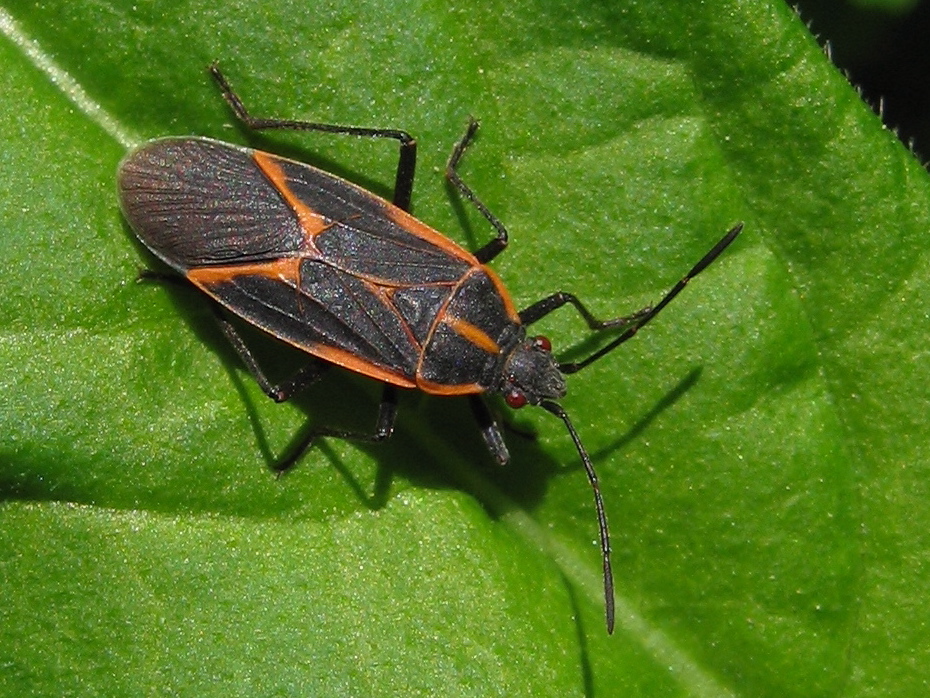
Tidbits:  Acer negundo is most famous for its relationship to the Boxelder bug (Boisea trivitattus).  There are many myths and misconceptions floating around about these little critters, so let's break it down.
1.  Boxelder bugs are found on all kinds of maple and ash trees, but greatly prefer A. negundo.  Only the female trees are hosts to the bugs.  They feed on low vegetation in spring, lay eggs all over the tree in mid-July, and start to move toward overwintering sites in fall.
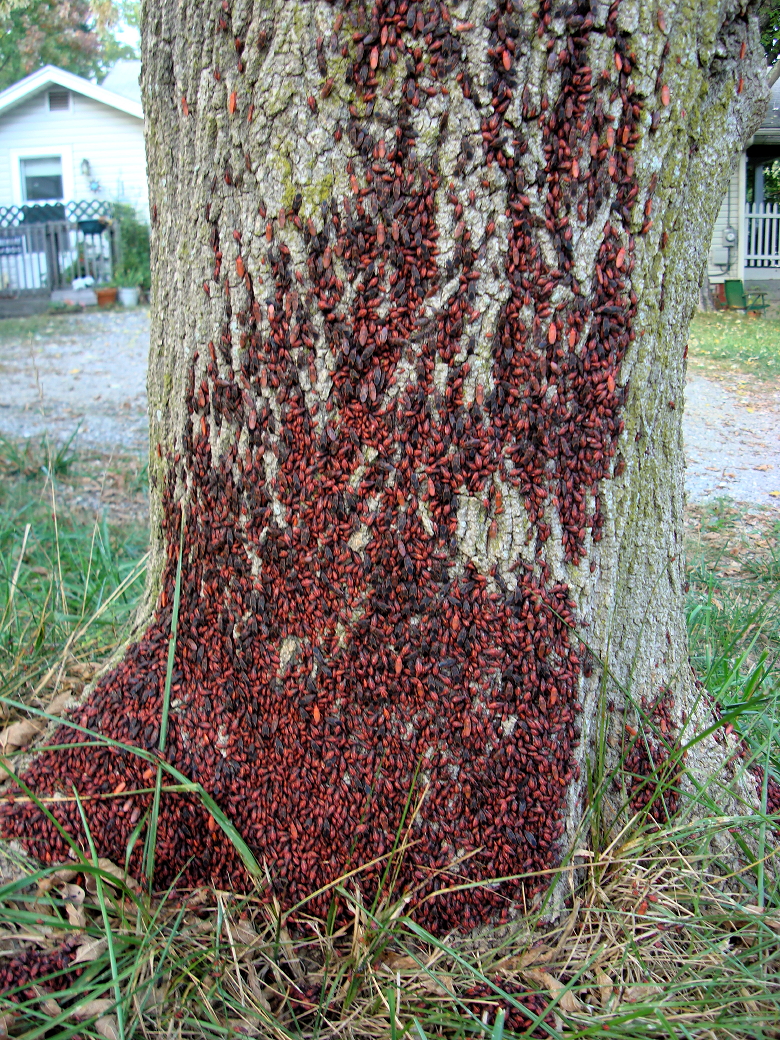
2.  These overwintering sites may very well be your warm, cozy house!  Some buildings are more susceptible to the invasion- namely, the sunniest ones (tall, good southern exposure).  Adults can travel up to two miles in search of a winter home, so chopping down the Boxelder tree in the front yard might not save you (although it may help).
3.  They don't bite.
4.  They don't cause any noticeable injury to their host trees.
5.  It's highly unlikely they'll gobble up your house plants.
6.  They might leave streaks of poo on your walls and curtains.  This is probably their greatest fault.
7.  The best defense is offense.  For a great reference on what you can do to seal up your home, see this U-MN Extension publication.
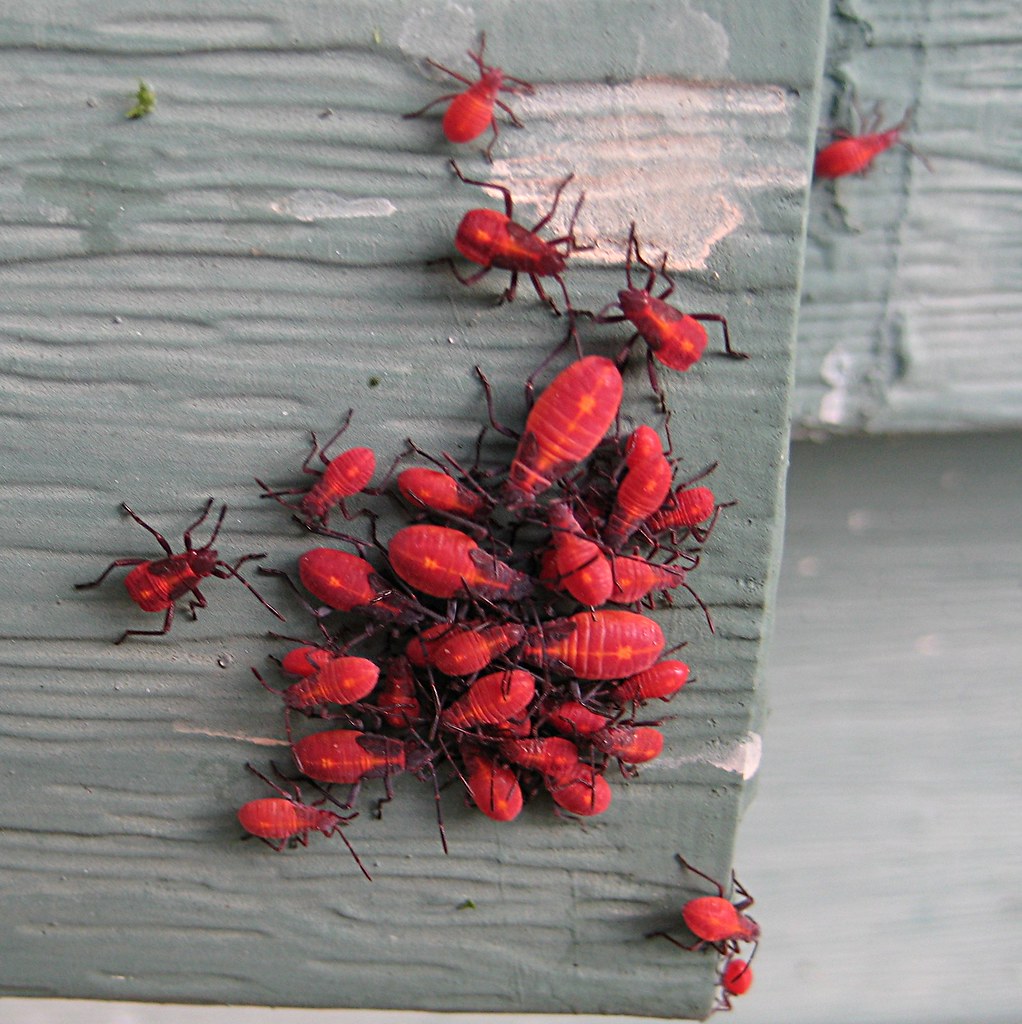
8.  You can find piles of the bright red nymphs throughout the summer.  They're harmless, fascinating insects to observe.
Boxelder is highly sensitive to 2,4-D (a common herbicide), and is susceptible to fire and mechanical damage due to its thin bark.
The wood is used for fiberboard, cheap furniture, pulp and fuel.  You can tap these trees in spring to produce maple syrup.
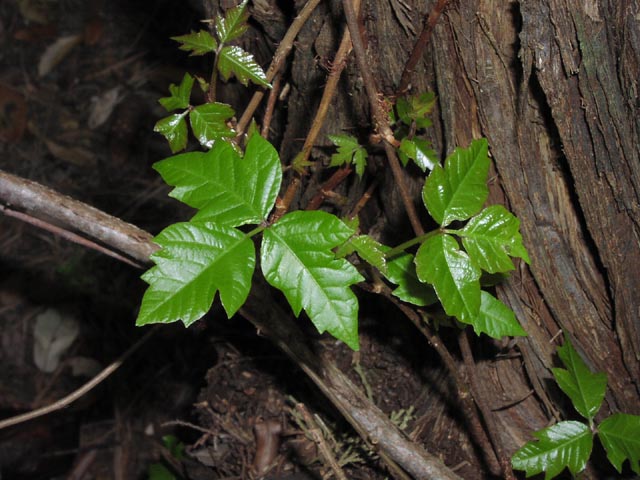
Seedlings and young saplings look a lot like Poison Ivy (Toxicodendron radicans-on the bottom in these photos).


Wild gardening:
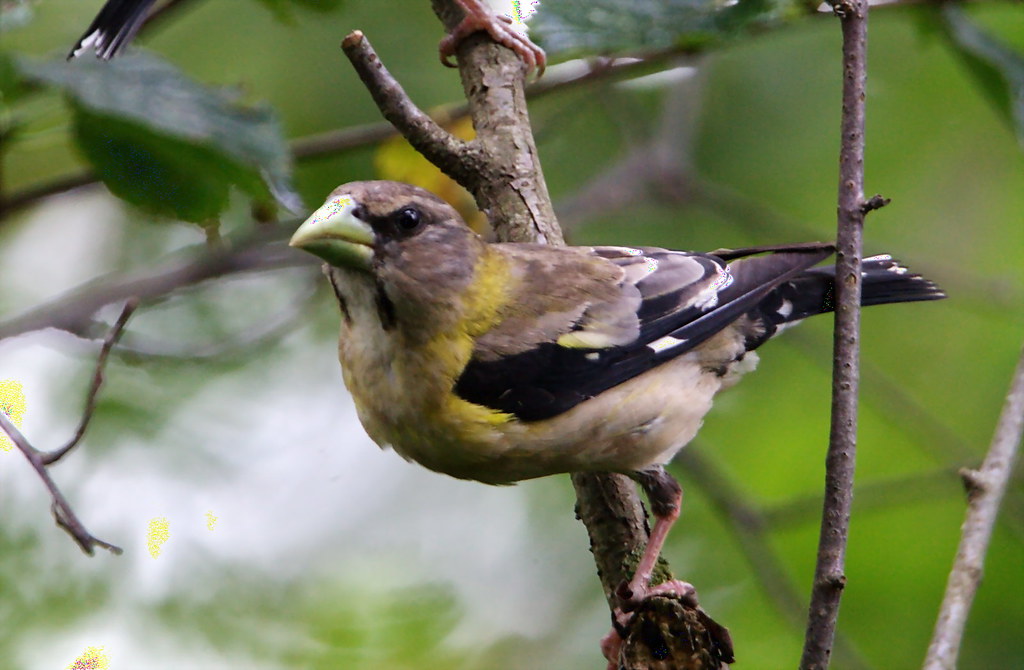
This is a fast growing, short-lived tree (avg. 60 yrs) that's hardy to Zone 2 and highly drought tolerant.  With it's prolific seeds and ready establishment, it has a tendency to become weedy or invasive.  It also suckers like crazy where branches have been cut or broken.  Maybe not the best choice for a tidy lawn, but fine for naturalized areas in the west.  In fact, it provides essential habitat factors for backyard wildlife.  Besides Boxelder bugs, it's a larval host to Cecropia Silkmoths (Hyalophora cecropia-mostly found in the east).  It's wind-pollinated but also visited by bees.  Squirrels and many birds, particularly the Evening Grosbeak (Coccothraustus vespertinus), feed on the seeds.


Spotlight On... features Montana native plants that are currently on display in our natural areas.  Have a plant that you'd like to see featured?  Let us know!

18 April 2010

Kootenai Nature Ramble

Kootenai Nature Ramble
I can't think of anywhere I'd rather have been today than strolling with my sweetheart through Kootenai Canyon.  A mellow trek through the heart of the Bitterroot Valley, sidling past shear cliffs to the roaring tumble of Kootenai Creek, around every bend a new sign of spring's rise and shine...it was a lucky day to be alive, indeed.
I saw my first Woodland Stars (Lithophragma parviflorum) of the season.
and the Western Trillium (Trillium ovatum) blanketed the forest floor.
We caught a charming little Gartersnake (Thamnophis sirtalis), which brought my snake-spotting count for the season up to five!
When the snake slithered off into a nearby hole, it led us to our best find of the day: this big ol' Western Toad (Bufo boreas).
He sat guarding the snake's hole like a sentry.  He was almost as big as Derf's face.
What a delight.  Farther on down the trail, we saw Ribes just about ready to flower...
...Clematis occidentalis leaves unfurling...
...and Hooker's Fairy Bells (Prosartes hookeri) in full bloom.
As we approached the burn area from summer 2009, one hillside in particular was blazing with wildflowers:
The pollinators were relishing in the new nectar sources.  Here's a Mourning Cloak (Nymphalis antiopa, MT's state butterfly) visiting a blooming willow (Salix)
Back near the trailhead, a peculiar bird caught my eye with it's darting acrobatics.  What at first seemed to be a huge swallow turned out to be a bat, cruising around in broad daylight.
An enchanting end to a perfect day.  What I can't show you in these photos is the call of the Osprey swooping overhead, the acrid earthy smell of the conifer needles underfoot, or the feeling of a warm and welcome breeze at your back.  Get out there.  Let me know what you discover.


19 February 2010

Spotlight On...Bearberry

Bearberry
Arctostaphylos uva-ursi
Ericaceae (Heath Family)
What's in a Name?  
The scientific name of Bearberry is quite literal:  Arcto and ursi both mean "bear", while staphyle and uva indicate "grapes" (or berries).  Not surprisingly, bears are quite fond of this fruit!  Also known as Kinnikinnick, from an Algonquin word meaning "item for mixing in" (to a smoking blend).

Quick ID:  
Look for Bearberry growing in dense, trailing mats along the forest floor.  It's one of our few broadleaf evergreens, with leaves that stay on all winter.  The paddle-like leaves are small (1-3 cm), leathery, and dark glossy green-turning reddish as winter moves in.  
Dainty pink-and-white flowers cluster in racemes at branch tips.  
Fruits are bright red, appearing in late summer and hanging on well into the winter.  

Range:
Found on well-drained foothill, montane, subalpine and alpine sites from Alaska to New Mexico.  Click here for MT range map. 

Tidbits:  
Bearberry has been used as a food source throughout history.  The berries are dry, mealy and bland.  Bearberry tea is widely used for many medical ailments, most notably for treating urinary tract infections and kidney stones.  However, ingesting too much can lead to constipation, and extended use has been linked to stomach and liver problems (esp. in children) and uterine contractions in pregnant women.
Bearberry leaves are high in tannin and can be used to tan hides.

Wild gardening:  
An excellent groundcover, particularly for dry sites and steep slopes.  It is tolerant of heat and cold (Zone 2-8), drought, and sun or shade.  Long-lived but slow-growing, Bearberry has no serious disease or pest problems.  Berries provide wintertime forage for birds and other wildlife.  Flowers attract butterflies and hummingbirds.  The plant is a larval host for Rocky Mountain Clearwing (Hemaris senta) moths, Hoary Elfin (Callophrys polios), Brown Elphin (Callophrys augustinus), and Freija Frittilary (Boloria freija) butterflies.

Spotlight On... features Montana native plants that are currently on display in our natural areas.  Have a plant that you'd like to see featured?  Let us know!