07 June 2012

VNS May Field Trips: Insects, Part 2--Beetles!


There are 450,000 species of beetles, and they make up 40% of all insects. So, I hope you'll forgive me for not being able to identify all of the species we saw on our field trips! We caught some amazing specimens: brightly colored ones, iridescent ones, and just plain adorable ones. The kids were superb insect collectors, and only a few bugs were accidentally crushed in the excitement (one of which, I will admit sadly, was a sneaky common cricket that I was trying to recapture). I will do my best at telling you what I know about the beetles I got pictures of--or about beetles in general.

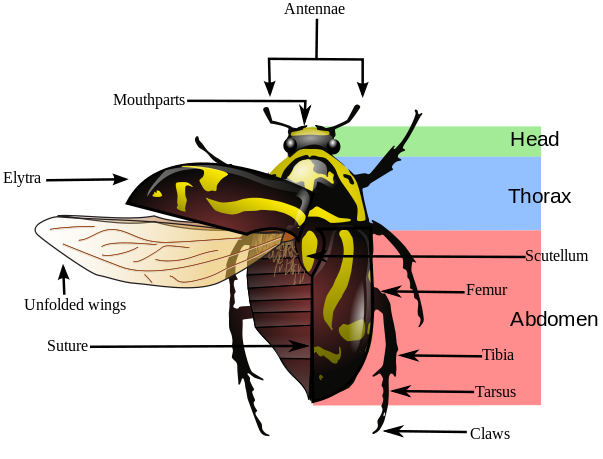
Here are the basic body parts of beetles, which I will refer to below. What isn't illustrated in the diagram is a section called the pronotum, or a portion of the front-most surface of the thorax. The shape and size of this feature is often very helpful in the identification of beetles.

Beetle #1: The lime green one on a pencil. 
Truly, I do not know what kind of beetle this is. It was a vivid, lovely color, though, and the kids who found it were ecstatic. 

 Beetle #2: The funny-colored lady beetle. Or, what reminds me of a Colorado Potato Beetle.
 This one came and landed right on my bracelet. He is shaped just like a lady-beetle--and there are 150 species of "ladybugs" in the U.S., so he very well could be one!

Entomologists think that lady-beetles may have spots to warn predators that they taste bad and can make them sick. See, ladybugs make a little bit of poison--just a little--and birds may be able to learn that a spotted beetle equals a terrible taste and illness.    

I'll admit, being a girl from a farm, my first thought was, wow, what a funny little, spotted Colorado potato beetle. Thankfully, this guy's pronotum and coppery-brown color set him off as something different. He's lovely, isn't he?

Beetle #3: A metallic-colored ground beetle (perhaps?)
If you Google the colors of this beetle (metallic green and copper-brown), you will get results for the notorious Japanese beetle--but this guy's colors are inverted and his shape is not the same. 


Do you know any of these beetles? If you do, tell us about them in the comments! We'd love to know!

06 June 2012

VNS May Field Trips: Insects, Part 1.

The insects station is, by far, the most active one in the spring. Sure, the hikes have lots of walking, but at the insect station, we wander around, run with nets, dump and scoop bugs with caution and speed, and work hard to draw and inspect. We don't really try to ID, but, as you will find, it is difficult not to know what to call a specimen we find. Naming something, however, is only part of the process, and  being able to describe it or draw it in detail is also important. Simply observing and marveling at something is worthwhile, too!

Christine W. helping with a multitude of bugs!
After the sometimes cold and often surprising weather of the first two weeks of field trips, things warmed up, the sun came out, and jackets were shed or tied around waists and we were able to focus on the bugs in the nets and crawling around on us. At least, in theory, we could focus. Sometimes we had insects in a bunch of places, which led to a multitude of things going on all the time.

This little guy is an Anthocharis stella, or a Stella orangetip, butterfly. Along the Pacific coast, the subspecies is a Sara orangetip, and the Stella was thought to be a subspecies; but recently, scientists discovered that the two (Sara and Stella) will cohabitate without hybridizing. You can tell the difference, I've learned, by the color of their marbeled underwing: Saras are darker grey-green, and Stellas are pale mossy-green.

In general, though, you can just call them all orangetip butterflies, if you'd like.


They are such beautiful little creatures! Variations of this species are found all over the world. In some, the females are white, like cabbage moths. In others, like these, both males and females have orange tips, but males have more pronounced dark borders on white wings, while females have a yellowish tint and lighter mottling on the underside of their wings.


Isn't that wing marbling neat?


Look at this grasshopper we found! He was bright green with brown legs, wings, and eyebrows. No really--he had eyebrows! It was very cool.

Now, there are at least 11,000 verified species of grasshoppers (Kevan 1982; Günther, 1980, 1992; Otte 1994-1995; subsequent literature), but still, I'm going to go out on a limb and try to identify him. I think he's some sort of band-winged grasshopper. I didn't stretch out his wings, but if I had, I bet I would have found bands of color on them.


The kids absolutely had a blast! Look at these little naturalists!

05 June 2012

VNS May Field Trips: Solo Hike.

Students on the solo hike get to put their naturalist skills they've learned to practice--all on their own. I heard many students say that they were surprised by how much they enjoyed being alone on a trail. A few times, they insisted they walk back along the solo hike trail in the opposite direction, again all alone.

Some discoveries:

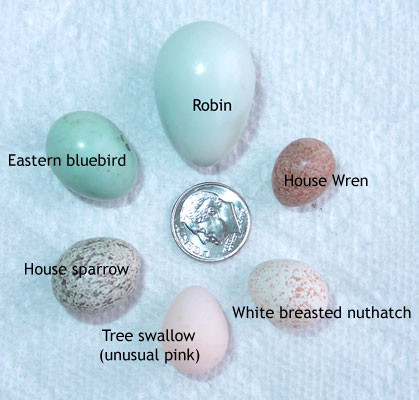
A tiny, blue egg. I found it along the trail at Fort Missoula, and have yet to get a confirmation of what kind of bird it belongs to! Of course, it is most probable that it was a robin's egg--but it was definitely no bigger than a quarter. Could it have belonged to someone else?


 Here's a chart I found of the sizes of eggs (some of which are blue) from someone in Connecticut. An Eastern bluebird egg is the same size, approximately, as a Western or mountain bluebird.

http://www.sialis.org/nests.htm
European Starlings can also have blue eggs. Their eggs are darker and smaller than robins' eggs, a little larger than a bluebird egg, and glossy, but without any spotting. If you want to have a go at IDing the egg we saw, do so in the comments!


 This group of kids at Council Groves enjoyed walking alone, and really loved skipping rocks along the river afterwards. They seemed so enthralled by being alone that I had to run around to gather them back togther to share their discoveries from the solo hike!
 

 At Fort Missoula, kids ate their snacks all crammed into the big log. These girls were all telling each other about things they had seen, and it from a ways off it seemed like the log itself was chattering.


04 June 2012

Spring at the MNHC!

As Allison said, so many exciting things have been happening this spring!

May ushered in the time of the year when we hold field trips for our Visiting Naturalist in the Schools program. This year, I had the opportunity to help with field trips held at Council Groves, Maclay Flats, and the Native Plant Garden at Fort Missoula, but field trips were also going on at a few other places. All hands were on deck. The warm weather (or, mostly warm) brought lots of exciting animals and plants out and about for all the naturalists to see.

For those of you who don’t know, Visiting Naturalist in the Schools is a program for grade schoolers (mostly fourth graders) aimed at helping young students develop their artistic, writing, and scientific skills to explore the world as naturalists. We do two “field study” sessions; the first is in October and the second is in May. Slightly different stations occur depending on the season. In May, we have three stations: the wildlife hike, the solo hike, and the insect study. These stations at the end of the year are especially exciting because we get to put all of the lessons we learned throughout the school year into practice. 

The next few posts are all about a few of the very exciting things we saw and experienced during VNS field trips in May!

Community Observations: What are you seeing?

Spring has arrived in a glory of rain and sun and flowers and green things growing.  It's a great time to be out and about, observing the natural world!  The staff at MNHC have been seeing lots of fun things:  Great Horned Owl young in a nest at Council Grove; Lazuli Buntings at Bass Creek in the Bitterroots; American Dippers braving wild run-off waterfalls along Sweathouse Creek; Osprey soaring over the Clark Fork River, looking for fish; the bright colors of Western Tanagers in back yards around Missoula; and dozens and dozens of wildflower species, from lupine to paintbrush to side-flowering mitrewort to fairy-slipper orchids.  


Where are you exploring this spring?  What are you seeing?  Please share in the comments!

27 February 2012

Bitterroot Valley surprises.

So often, we tend to think of "natural history" in terms of the arguably more traditional definition of nature, specifically as the world surrounding humankind but existing independently of or uninfluenced by human activities.Certainly, this is a major part of natural history (the history outside of our own species), but it's so important to also include the history that involves our coexistence with and stewardship of the natural world.
2012 © Sara J. Call
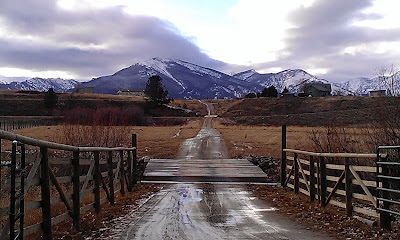
Which brings me to The Big Ditch. There is a large canal that begins at the corner of Lake Como and stretches up past Stevensville to the bench lands southeast of Florence, delivering water to agricultural land (over 1,300 users) along a span of 75 miles. It is 25 feet across at the Lake, and gradually dwindles to a third that size before petering out to transect ditches completely. 

2012 © Sara J. Call
2012 © Sara J. Call
If you grew up in agricultural land as I did, you know that even though water only fills canals and ditches for a few months out of the year, they create a significant amount of riparian-type habitat. And even though they go in relatively straight lines and don't meander like streams and creeks we like to picnic alongside, they are home to many of the same creatures we know and love near other waterways. 

The Big Ditch (more formally known as the Bitter Root Main Canal) has an impressive history. Copper King Marcus Daly first conceived of a giant canal when he moved to the Bitter Root Valley and founded Hamilton in 1887. He built a few irrigation projects in the area, but his plans for a "big ditch" along the length of the entire valley were ended by his death in 1900. That same year, though, an intrepid business man named Samuel Dinsmore joined the irrigation game, and made plans to build a pipeline and canal that took water from the west fork of the Bitterroot River and ran parallel the river to Hamilton. After a few years, when finances ran low, he attracted wealthy investors from Chicago to finance his project, and it was then he founded the Bitter Root Irrigation Company and added the plan to take water from a storage-worthy fortified Lake Como. The scheme included the grand idea to buy up cheap land, bring irrigation water to it all, and resell hundreds of "orchard plots" to out-of-towners for a hefty profit. So, the "Apple Boom" of Western Montana was launched into full gear. Hundreds of speculative land buyers came to partake in the supposed fruit cornucopia of the Bitterroot Valley. The Big Ditch was dug with massive steam shovels and communities were constructed, and the since-burned lavishly glamorous Bitter Root Inn was built. The promotional scheme seemed to be working.

But farmers found they could not afford to pay for water rights, and the land was not as perfectly suited for McIntosh apples as advertised. By 1917, the Bitter Root Valley Irrigation Company went bankrupt, and finally in 1920 the company became a municipal corporation run by the farmers that remained to raise livestock, vegetables, and wheat. Only a few orchards remain. 
2012 © Sara J. Call

But the ditch remains. There is no sign or historical plaque marking it. It is still fully operational. And it is impressive; from Lake Como, it is sent up on to a bench on the west edge of the valley, then, a few miles later, it goes into a massive pipe, off a steep hillside, and disappears under Highway 93. It reappears on the other side of the pavement and crosses over the Bitterroot River, where it threads across the valley and weaves along the bench lands paralleling the river along the Selway Range. 

2012 © Sara J. Call

I managed to follow it and intersect the ditch every so often along its length. I took unpaved residential roads, followed the Skalkaho Pass road, got lost in rural neighborhoods following transect ditches up to their origins, and found myself amazed at the immensity--and beauty--of the irrigation project.    


While out on a side road that I had successfully found crossed the Big Ditch, I paused to take a photograph at a sweeping bend of the canal that held some water from both snow melt and a dripping pipe that funneled a creek across near the bridge. I was stunned when I heard the following sound, and then saw its creator:
2012 © Sara J. Call


Yes, that's right; the red-winged blackbirds are beginning to return; spring is imminent! (I believe the one I heard and saw was a bachelor or yearling red-winged blackbird, recognizable by its muted or orange shoulder patches. These young guys return to gather in bachelor flocks rather than stake out territory like older males. He was smaller and up in a tree, not down near an obvious nesting site along the canal.)

All in all, what a magnificent adventure. And what a wonderful reminder that our cultural history remains so intertwined with that of the natural world, that even the things that many may believe are a threat to the natural world (ie: agriculture) also (or rather) provide habitat for the creatures with which we coexist.

As the sun set in the Bitterroot Valley, and as I paralleled the last leg of the tapering Big Ditch, I saw a group of white-tailed deer pause in a dry grass-filled pasture. The clouds were painted pink in the sky above them, and for a moment they looked curiously toward me before lifting their fluffy tails and bounding away toward higher ground. Below us, the lights of the city of Stevensville twinkled. The Bitterroot Valley held so many lovely surprises.   
2012 © Sara J. Call


For further information:

23 February 2012

February in the Bitterroot.

Nearly a month ago, Bitterroot Bill (the yellow-bellied marmot, cousin to groundhog Punxsutawney Phil) predicted the imminence of spring--or, more accurately, he didn't show himself at all on the overcast Groundhog Day at the Lee Metcalf National Wildlife Refuge. That may be hard to believe with all the winter storm warnings we have been getting, but we can always hope.
© Sara J. Call 2012
There's quite a bit less snow in the Bitterroot Valley, and quite a bit more sun. I drive out there every so often to get out from under the grey skies that have been frequenting Missoula Valley as of late. Even when the sky is overcast in the Bitterroot, it will open up to let rays of sun burst through, which is always wonderful. Last week, I drove down through Stevensville and took a loop through the Lee Metcalf Refuge to catch those rays of sunlight. There's a surprising amount of bird-watching to be had along the ponds, even now. Before long, I'm sure one will be able to spot a muskrat or two patrolling the thawing waterways.
© Sara J. Call 2012


Briefly, some interesting history about Lee Metcalf National Wildlife Refuge: it was founded in 1963 and renamed to 'Lee Metcalf' in 1978 in honor of the late senator that helped establish conservation projects across the state of Montana. The refuge is a total of 2,800 acres. Natural trails wind through 160 acres of ponds, sloughs, and river bottoms. While it predominately caters to providing habitat for migratory birds, the refuge also contains plenty of other creatures: beavers, muskrats, osprey, and yellow-bellied marmots, to name a few. Fish are also protected residents. The habitat is actively managed, meaning that people control water levels using siphons and pumps; provide weed control using fire, mechanical means, and sometimes cattle; and allow sportsman to come birding during hunting season. All of the management techniques are necessary to help maintain healthy wetlands and riparian areas in the refuge, where the riparian zones are human-enhanced and dependent on periodic drawdowns.


The Bitterroot Range provides a wondrous backdrop to the wetlands. I saw dozens of ducks (mallards and others) and Canada geese, and watched an American coot dabbling near the shoreline, tipping forward and bobbing with tail pointing skyward for a few moments before settling back upright on the water to swallow whatever he had found to eat. 

© Sara J. Call 2012

© USFWS Mountain Prairie


A great blue heron stood reflected in a small pond as the sun set, and the clouds were splashed with an amazing array of pink and purple that we rarely see in Missoula skies. Before I could document the moment in a photo, the heron hunched his lanky frame and lifted away into the dusk, scattering droplets of water like beads.

 In the coming months, the red-winged and yellow-headed blackbirds will return, which is my favorite time of spring. You can definitely bet on good birdwatching at Lee Metcalf NWR, year-round. 


See our spring post on the birds of Lee Metcalf from last year here.

REFERENCES:
"Get Ready For Spring" - NBC Montana, 2 Feb 2012
"Lee Metcalf Refuge Revitalizes Pond with Fire, Cattle" - 4 Nov 2011
Montana Birding Trail - Lee Metcalf NWR
USFWS Lee Metcalf National Wildlife Refuge website
Wikipedia entry