06 July 2011

July Observations - What Have You Been Seeing?

It's July, the weather is glorious, and summer is here!  This is the time when lots of folks are getting outside, taking hikes, exploring the rivers, going on backpacking trips.  Please share what you're seeing (and where you're finding it!).  

Two weeks ago I went on an amble up Waterworks Hill and saw a family of mountain bluebirds: 
The parents were feeding their little fledgling, who must have been just out of the nest:
Aside from this lovely sight, I saw several other bird species, including:

western meadowlark
black-headed grosbeak
American goldfinch
black-billed magpie
northern flicker
warbler sp.
chipping sparrow
eastern kingbird
raven
western bluebird
house finch
red-breasted nuthatch
    So--what are you finding, on your outdoor explorations? 
    We would love to hear about it!

    06 June 2011

    Woods Gulch Hike

    Now is definitely the time to go seeking out wildflowers!  A hike up Woods Gulch this past weekend awarded views of FIFTY-TWO plant species in full bloom.  Gorgeous!  Here's what you may see if you amble up that lovely little trail anytime soon:
    side-flowered mitrewort
    twisted stalk
    false Solomon's seal (two species)
    western trillium
    black gooseberry
    serviceberry
    hawthorne
    meadowrue
    stream violet
    dandelions
    shooting stars
    ninebark
    clematis
    stinging nettles
    baneberry
    arrowleaf balsamroot
    desert parsley
    blue-eyed Mary
    pussytoes
    Canada violet
    false boxwood
    mountain ash
    kittentails
    stoneseed
    miner's lettuce
    draba
    groundsel
    Oregon grape
    prairie/woodland stars
    kinnikinnick
    Rocky Mountain maple
    white arabis
    purple arabis
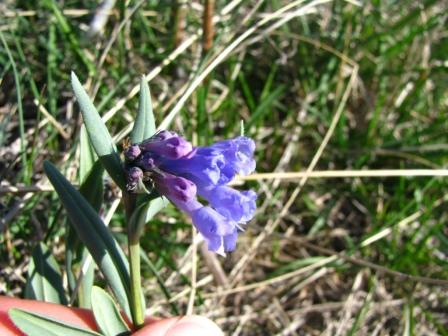
    bluebells
    heart-leafed arnica
    alumroot
    wild strawberry
    wood strawberry
    glacier lilies
    early blue violet
    sitka valerian
    waterleaf
    fairybells
    paintbrush
    huckleberry
    shooting stars
    9-leaf desert parsley
    collomia
    lupine
    penstemon
    larkspur

    What are you finding on your outdoor explorations?

    13 April 2011

    Mystery Tail!

    One of our staff naturalists brought in a tail that she found near her property in Lolo.  It is rather flat, but that may be due to the fact that it was buried under a thick layer of snow for much of the winter.  Does anyone have any guesses as to what it may be?
                        Click on the pictures for a bigger view.
    We have a few guesses as to the species here at MNHC, but we aren't quite sure, so we're open to any suggestions and thoughts you may have.  Please share your ideas in the comments!

    04 March 2011

    Spring Migration

    The spring migration is urgent and depending on the species of birds, there is a specific optimal time when the birds need to arrive for breeding.

    So who arrives first?

    Yellow-headed Blackbird: March 16 - April 30

    Yellow-headed Blackbirds have a very systematic migration plan. Traveling to Montana from as far south as central Mexico, yellow-headed blackbirds migrate in large flocks that are segregated by sex and age. Arrival on the breeding grounds in spring is an orderly process. Mature males migrate first, followed by mature females as much as two weeks later. Next come the first-year males, followed in about a week by first-year females.

    Swainson’s Hawk: April 1- April 30

    The fall migration of this species is a spectacular phenomenon, as virtually all of the world's population of Swainson's Hawks funnels through Central America within a few days. Until very recently, these hawks were thought to disperse across the whole of South America, and no one really knew where or how they spent the northern winter.

    Who are the final migrants to arrive?

    Yellow Warblers: May 1 - Jun 15

    The first Yellow Warblers to arrive in the U.S. are those that will reach southern California in mid-March. These birds, representing two subspecies, pass up the Pacific coast and reach southern Alaska by mid-May. The other five subspecies will arrive in the U.S. in early April. Their movement is rapid; some of these birds will reach the Great Lakes region before the end of April, and others may arrive in interior Alaska by mid-May. But for us, we will see these birds come May!

    Western Tanager: May 16 - Jun 15

    The majority of this striking species winters in southwestern Mexico and Central America. The actual migratory routes of Western Tanagers are largely unknown. These birds are nocturnal migrants that travel at high altitude covering great distances in one night!

    All of these birds can be spotted at the Lee Metcalf National Wildlife Refuge.

    Click Here for a list of all birds living at Lee Metcalf National Wildlife Refuge.

    For more information on bird migration, check out the eNature website.

    28 February 2011

    Great Grey Owl Sighting

     This past weekend, Robin Childers, one of our Master Naturalists, got a call from a friend that a Great Grey Owl was hanging out in their neighborhood.  She dashed over, camera in hand, to investigate, and got some lovely pictures of this beautiful bird, who was hanging out on a powerline on 7th St. in the Target Range area.  
     Great grey owls hunt during the daytime, and this one seemed very tolerant of the small crowd of curious folk nearby.  
     What exciting wildlife have you been seeing lately?  Please share!

    09 February 2011

    A Guide to a Montana Winter

    We all know that winters in Missoula can get pretty gloomy and we find ourselves just sitting inside waiting for sunny weather.  But there is a cure!  Here are a few upcoming events that you can do this winter in Missoula and the surrounding areas.

    Montana Natural History Center:
    The Montana Natural History Center offers great activities all year long.  Saturday Discovery Days are offered nearly every month for adults (and families) and feature different educational topics about Montana wildlife.  The Winter Raptor Workshop is this Saturday, February 12th.  Spend an incredible day seeking out raptors with Denver Holt, renowned wildlife researcher, naturalist and founder and president of the Owl Research Institute. Learn winter raptor natural history, gain insight with helpful raptor identification tips and experience the wonder of winter raptors.
    For more information about community activities and Saturday Discovery Days click here.

    Even though the Master Naturalist classes are full for the winter and summer, you can sign up for our Fall 2011 course!  This is for any adult who is enjoys learning about the natural world, sharing knowledge with others, and supports conservation. If you enjoy hiking, bird watching, following tracks, or identifying wildflowers, you’ll love being a Montana Master Naturalist.  For more information click here.

    Montana Winter Events and Festivals:
    I recommend going to any winter festival you can.  I just came back from the winter carnival in Whitefish and had a blast!  For all things winter in Montana click here.

    On February 19th and 20th, the Northern Division Freestyle Competition is coming to Missoula.  This annual event features the best skiers in the area for moguls, freestyle competition and jumping.  For more information click here.

     If you're willing to take a drive, you can also visit Whitefish on February 19th for the Moonlight Dine and Ski.  Come for an evening of fantastic cuisine and winter adventure. Watch the moon rise from the summit, feast on delicious dishes, top it off with some dessert, then click into your bindings and ski or snowboard down the mountain by moonlight. Or, for guests who prefer, climb aboard the Big Mountain Express chairlift for a smooth cruise back to the village.  For more information click here.
    The Moonlight Dine and Ski will also be celebrated on March 19th, for those who cannot make it in February.

    Starting February 11 through the 20th Missoula is hosting the Big Sky Documentary Film Festival.  It showcases the best in documentary films from around the world. The festival attracts more than 10,000 people and screens more than 100 films during the week-long event. All films are shown on Montana's largest movie screen at the historic Wilma Theater, downtown Missoula. Filmmakers from around the world will be in attendance to address audiences after their films screen. Tickets and passes are sold at the Wilma Box Office. For more information click here.

    And, of course, there's always cross-country skiing and snowshoeing if you need a fun and inexpensive way to enjoy the outdoors.  Look up snow conditions for surrounding cross-country ski trails here.  This has been a great winter to ski in the Rattlesnake and Pattee Canyon, and getting out for even an hour of exercise in these winter wonderlands is enough to drive away the blues and bring a smile to your face!  You can rent skis and snowshoes quite affordably at places like the Trailhead, REI, the Army-Navy Store, and the University of Montana outdoor program (for Griz card holders).

    If any one has other great ideas of things to do this winter don't hesitate to leave a comment.  We'd love to hear some of your ideas!
      

    03 February 2011

    Spotlight On...Redtwig Dogwood

    Redtwig Dogwood
    Cornus sericea
    Cornaceae (Dogwood Family)
    Quick ID:
    Redtwig dogwood is full of character throughout the year.  In its leafless winter state, the conspicuous red branches set off a blaze of color against the snow.
    Early spring brings dense, flat-topped clusters of creamy white flowers, which give way to pea-sized white berries in summer.
    Cooler temperatures bring out purple and red anthocyanins in the leaves--the mass fall display of a dogwood thicket can really take your breath away.  Look for this loosely spreading deciduous shrub, typically 6-12' high, growing in dense thickets in riparian areas and open forests.
    The red twigs are tipped by a uniquely pointed terminal bud, and can be covered in lenticels on the old growth.  Leaves are opposite (arranged in pairs along the stem), simple (not lobed), with entire (not serrated) margins that tend to be wavy and occasionally rimmed in purple.
    Notice the way the veins sweep up toward the tip of the leaf.  This is a great identifying feature that can be used to distinguish dogwood from the many other simple-leaved species out there (chokecherry, twinberry, huckleberry...I'm looking at you).
    Range:
    Very common throughout Canada and the northern US, south to Virginia on the east side and northern Mexico in the west.  Look for it growing in the rich, moist soil of riparian areas and in forest openings, in conjunction with alder (Alnus spp.), willow (Salix spp.), cottonwood and aspen (Populus spp.), Wood's rose (Rosa woodsii), currants (Ribes spp.), Rocky Mountain maple (Acer glabrum) and horsetails (Equisetum spp.).
    What's in a Name?
    Cornus is the Latin word for horn (like a unicorn).  The Romans called the dogwood "cornel", in reference to its wood, which is hard as the horn of a goat and useful for making a great many things.  This is also a convenient way to remember the distinct leaf buds of redtwig dogwood, which are narrow and pointed like horns.
    The species name sericea means silky, in reference to the fine hairs covering the leaves.  The origin of the word "dogwood" itself is not totally settled.  It may be a corruption of "dagwood", from the use of its hard wood in making dags (or daggers).  Alternatively, there is some evidence that a concoction of English Cornus leaves was used to treat dog mange in 17th century herbology.
    C. sericea is also commonly known as redosier dogwood.  This may be confusing, since "osier" comes from the medieval term for willow (Salix sp.)  In fact, the flexible young branches of C. sericea have long been used for basket weaving, much like the willows that grow in similar streamside thickets. 
    Tidbits:
    Like most of our native plant species, dogwood has been, and continues to be, valued for its many benefits to humans.  An extract made from the leaves, stems and inner bark can be used as an emetic for treating fevers and coughs (and a great many other ailments), and the inner bark scrapings have long been added to tobacco smoking mixtures.  The red stems not only produce colorful weaving patterns, but can be used to make red, brown and black dyes.
    The white berries, although tart and bitter, are not poisonous, and have been eaten by many people throughout history.  The fruits are low in natural sugars, making them less attractive to wildlife and less likely to rot than other berries.  Thus, dogwood fruit persists long into the winter, making it available when other food is not.  These unlikely berries are a key food source of grizzly and black bears, and are also eaten by songbirds, waterfowl, cutthroat trout, mice and other animals.  Beavers use the hard wood to build dams and lodges.
    Thickets of dogwood are especially good habitat for little birds like the dusky flycatcher, orange-crowned warblerLincoln sparrow and the house finch pictured here.  These thickets, often located along the river's edge, provide good places to rear young, with year-round security and food sources.  Because of its thick root system, redtwig dogwood is also important for stabilizing these streambanks, particularly in places where stream channels are scoured by seasonal flooding.
    Wild Gardening
    Being a water-loving species, Cornus sericea is tolerant of moist soils and varying water tables.  Once established, it also holds up well against drought.  Research has shown that water-stressed plants actually have a higher tolerance to freezing cold temperatures.  When dogwood senses the shortened days of oncoming winter, tissue changes occur that prevents the plant from taking up water and increases water lost through transpiration, so the tissue becomes dehydrated even when water is abundant.  This interesting adaptation, along with C. sericea's somewhat complex ability to avoid freezing injury by having water freeze outside of its cells, should make it an incredibly cold-hardy choice for northern gardeners.  BUT, remember the notorious cold snap of early October, 2009, when temperatures across Montana took a sudden dive into the single digits?  Our 11-year-old redtwig dogwood--10' tall and strong as an ox, we thought--was the only significant plant we lost at the Nature Adventure Teaching Garden here in Missoula.  Granted, all the plants at the NATG are dynamite no-fear natives that can take most anything the weather throws at them, so the garden's overwhelming hardiness came as no surprise.  The loss of Big Red was a sad one, though.
    Luckily, dogwood is easy to propagate by seed, layering or stem cuttings, and easy to establish in a range of soils.  This is one shrub that will do fine in partial shade as well.  And while the tender stems are preferred browse for deer, elk and moose, they're less enticing that many of the delectable non-native shrubs commonly planted as ornamentals.  Aside from all the wildlife you'll be providing backyard habitat for, you'll also be enticing pollinators and butterflies with the fragrant white blossoms in spring (C. sericea is an important larval host for the Spring Azure (Celastrina ladon) butterfly.  Overall, this is one of the best all-purpose native shrubs to plant for ease of care and year-round enjoyment.
    Thanks to Dave DeHetreBryant Olsen and Paul Alaback for some of the images used here.
    Spotlight On... features Montana native plants that are currently on display in our natural areas.  Have a plant that you'd like to see featured?  Let us know!