29 October 2010

Lovely Larchiness

Larches have become one of my favorite trees since my move to Montana five years ago.  My first autumn here, I took a drive east on Highway 200, and I remember asking my friend, "What's wrong with all those trees?" as we passed hillsides covered with yellow-needled larches.  I thought they were dying.  Little did I know!  Now I'm married to a botanist and naturalist whose favorite tree is the larch, which means I've learned lots about these amazing trees in the past couple of years.  And the more I learn about them, the more I am fascinated by them.

Alpine larches at Glen Lake
Though there are about 10 different species of larch worldwide, we have just two types of larches (or tamaracks) here in western Montana, the western larch (Larix occidentalis) and the alpine larch (Larix lyallii).  What makes these trees unique among conifers is that they are one of just a handful of genera that are deciduous.  In the fall the needles turn a glorious golden color that splashes across the landscape, a bright contrast to the deep greens of the pines and firs and spruces.  In the spring, that same bright contrast is evident, but this time the color is the vivid green of new growth.  Whether it be spring or fall (or, for that matter, anytime in between), the lovely larch is worth searching out.  

In Donald Peattie's A Natural History of Western Trees, he writes, "Concerning the Alpine Larch the fact which even most naturalists know best is that they have never seen it.  And so scattered is its growth, so wild and inhospitable its favorite haunts at timber line . . . that most people would not know where exactly to begin to look for it."

Yet here in western Montana, we can (comparatively) easily walk among the Larix lyallii.  If you haven't yet done so, I highly recommend you change that.  One of the easiest spots to reach, after just a two-and-a-half-mile hike, is Glen Lake in the Bitterroot Valley.  Carlton Ridge/Lolo Peak is another great spot for alpine larches.  This year my husband and I took our alpine larch pilgrimage to the Bass Creek Overlook, just as the colors were peaking at the end of September.  (A word to the wise:  this trail gets pretty steep--but the larches are worth it!)

Alpine larches at Bass Creek Overlook
Besides being a place that provides fairly easy access to the alpine larch,  we in western Montana are also near one of the very few places where Larix lyallii and Laruix occidentalis hybridize.  This happens not only because the ranges overlap here (there are quite a few places where this is the case), but because of of the unique geography of the area.  In places like Carlton Ridge (just below Lolo Peak), where there are steep, north-facing slopes, alpine larches creep down the slope while western larches creep up, and the two species hybridize.  Now seeing a hybrid larch is definitely worth putting on the bucket list!

Alpine larches, which are found at elevations of 4,000-8,000 feet, tend to turn golden and shed their needles about a month before their lower-elevation (2,000-7,000 feet) counterparts.   But if you missed the alpine larches changing color, do not despair!  You still have time to enjoy the changing colors of our western larches (which also  have the advantage of being much easier to get to).  There are even a few in various yards around Missoula, if you know where to look.  So now is the time to go take a walk in the Rattlesnake, or Pattee Canyon (see below--this was taken just yesterday, on on October 28th), 

Western larches at Pattee Canyon
or along the Kim Williams trail.  Or, if you don't mind a little driving, Seeley Lake has some spectacular old-growth larch stands, including what is claimed to be the largest Larix in the world.  

Aside from their deciduous nature, larches can be identified by their clusters of needles, which are found in groups of 15-30 on western larches and 30-40 on alpine larches.

    
alpine larch needles
western larch needles


Western larches have thin, scaly bark when they are young, but as they mature the bark thickens--up to 3-6 inches thick on old-growth trees.  As the trees age, the bark darkens to a reddish-brown, and comes to look very much like the puzzle-bark of Ponderosa pines (though without the intoxicating vanilla fragrance).  The thick bark helps protect the larch from fires, as does its ready ability to create new needles.  Larch trees are also able to sprout new branches from the side of their trunks, yet another unique adaptation that gives this species a high survival rate from forest fires. 

While there are a plethora of fascinating facts about larches, what may be most important to note is that they are here, in western Montana, and that we have the good fortune to be able to see them with so very little effort.  So don't just drive by their changing beauty at 75 mph on the freeway--take the time to seek them out, walk among them, and absorb their loveliness.  And if you want to share your favorite larch-viewing place, that would be wonderful!


22 October 2010

Spotlight On...Rubber Rabbitbrush

Rubber Rabbitbrush
Chrysothamnus nauseosus
Asteraceae (Sunflower Family)
Quick ID:  
In general, Rabbitbrush appears similar to Big Sagebrush--a scrubby shrub with grayish-tinged, woolly leaves.  Like sagebrush, it's found in dry, open plains or disturbed sites, and grows about 1 to 6 feet high.  The leaves are linear and alternate on flexible stems.  The yellow flowers bloom late (August-October), blanketing the plains and slopes with the type of brilliant display most flora exhausted months ago.  Being in the Asteraceae family, each flower is actually a loose cluster of mini-blooms known as "disc flowers", like the ones in the eye of a sunflower or daisy.  The "ray flowers" that we know as petals in other Asteraceae species are absent in Rabbitbrush.  
Range:
Found up to 10,000', from Canada to Mexico, east of the Pacific mountain system and stretching to the Great Plains.  Look for it growing near dryland bunchgrasses and shrubs like Big Sagebrush (Artemesia tridentata), Basin Wildrye (Leymus cinereus), Mountain Mahogany (Cercocarpus ledifolius) and Bluebunch Wheatgrass (Pseudoregenaria spicata).
What's in a Name?
A quick note on taxonomy:
It's the most fickle sport among scientists, always in flux and impossible to keep up on.  It's not so easy to remember all this archaic Latin binomial nomenclature, and once you think you've got it down, a new taxonomical relationship is discovered or refuted, groups are shuffled around, and the 15 syllable name you've been proudly slipping into casual conversation and engraving onto your garden signs is now obsolete.  So if you're the type to stick with what you know and ignore all the newfangled monikers, I, for one, won't judge you.
That said, Rubber Rabbitbrush is technically known as "Ericameria nauseosa (Pallas ex Pursh) G.L. Nesom & Baird", but in my heart of hearts, it will always be Chrysothamnus.  Chryso- means gold, -thamnus a thicket.  The "nauseous" root in the specific epithet is in reference to the strong smell the plant gives off, rather than the idea that ingesting it will make you sick.  In fact, the plant's thick latex has been used for centuries as a sort of chewing gum (hence the "Rubber" part).  It provides shelter for and is eaten by rabbits and other small mammals.
In some southern parts of the country, Rabbitbrush is known almost exclusively as Chamisa, from the Spanish word for brush or kindling, and ultimately derived from the Latin chama (-->flamma-->"flame").        
Tidbits:
The presence of Rabbitbrush, which often grows on very poor soils, and is considered a useful indicator that land is eroded or overgrazed.  It can be an important winter forage for antelope, mule deer and elk on depleted rangelands, but is sometimes reported to be toxic to livestock.
The plant has a few adaptations that allow it to thrive in arid, inhospitable places.  It's tolerant to a wide range of soil types, alkalinity, salinity, cold and drought.  The felt-like fuzz covering the stems (technically known as trichomes) acts as insulation and reduces water loss.  The light gray stems also reflect more heat than dark green leaves would, keeping the shrubs cool as a cuke in the harsh summer sun of the open prairie.
Historically, Rabbitbrush has been used to make yellow or green dye, and prepared as a tea to help coughs and colds.  The flexible twigs are good for baskets, and the seeds can be ground and used much like cornmeal.  
People have been looking for a way to use the natural latex found in the roots and inner bark to produce rubber since the 1930s, but haven't found a commercially viable way to extract it.  There is currently an investigation underway by the University of Nevada, looking at the potential of Rabbitbrush as a multi-use industrial crop for biomaterial and bioenergy applications.  Here's the interesting project summary.

Wild Gardening:  Plants need about 4' of space, and take about 4 years to mature.  They tend to produce about a million branches, generally arising from a common point and not overtaking neighbor plants.  Overwatering or fertilizing can produce leggy, sprawling plants.  New plants sprout up from the roots and can be divided, and the seeds germinate easily.
Being a late bloomer, Rabbitbrush fills an important niche both as an ornamental perennial and a fall pollen source for bees, flies and butterflies.  To see this plant in late fall, spilling over with brilliant color and buzzing with hundreds of hungry and deprived insects, is really incredible.  It tolerates fussing-over, but seems to delight in neglect: no extra water, no soil amendments, no pruning or deadheading.  The soft, pale branches complement the muted palette of a xeric landscape perfectly, and provide a safe haven for nesting birds and other small animals.


    Spotlight On... features Montana native plants that are currently on display in our natural areas.  Have a plant that you'd like to see featured?  Let us know!

31 August 2010

What Have YOU Seen?

We so appreciate Kim Birck sending us her observations this summer, and we want to know what everyone else is seeing on their excursions out and about in Montana (and beyond!).  So, what have you seen this summer?  

Moose?  

Grizzlies? 

Bald eagles?  

Cedar waxwings?  

Here's a picture of a western tanager that I saw while hiking up the main trail of the Rattlesnake at the beginning of the summer:


Post your observations in the comment section, or send an email to adejong [at] montananaturalist.org if you have pictures you'd like to share.  We can't wait to hear from you!

26 August 2010

American Dipper Nest

We have a few more pictures from MNHC friend Kim Birck, this time of an American Dipper nest she and her husband observed while backpacking in Idaho's Sawtooth Wilderness.  Here are her comments:

These pictures are of the mossy nest of an American Dipper (Cinclus mexicanus), also known as the Water Ouzel. The dipper was reportedly John Muir's favorite bird. The name "dipper" is for the bobbing motion this little gray bird makes as it stands on a rock or log in fast-moving water.


This nest was located on the side of a large rock in the middle of the falls between Middle and Upper Cramer Lakes in the Sawtooth Wilderness area near Stanley, Idaho. 


We were camped right above the falls from July 24 - 27, and were able to watch the parents coming and going, and hear the excited noises made by the chicks during each visit. 

According to my bird books, both parents feed the young, but the female does most of the work. We witnessed both parents in action, though we could not tell who was who. This may have been a second nesting, as the bird books indicate that dippers nest as early as late April. (Or maybe because of the elevation and late snowmelt, it could be a first nest.)


We watched the parents "dipping" and walking right into and under fast-flowing water in search of aquatic invertebrates to feed their young. As they entered the water, we could see a couple of their adaptive features: the protective white nictitating membrane that slides over their eyes and the extreme water repellency of their feathers.


We have seen dippers in the Missoula area, particularly in the upper reaches of Grant Creek, and have been aware that they had a nest - somewhere - but this was the first time we could actually SEE a dipper nest and watch the feeding activity.


It was fascinating to watch, and listen to, the dipper family during our 3 nights on the Cramer Lakes. 

20 July 2010

Photo Essay of a Cordilleran Flycatcher Nest

The past few weeks have been nesting time for many birds in our area.  One of MNHC's long-time volunteers and supporters, Kim Birck, has been watching one type of bird--and one nest--in particular, a pair of Cordilleran Flycatchers (Empidonax occidentalis) who chose her power box upon which to build their nest.


Cordilleran Flycatchers are small birds with greenish-brown backs, yellowish underparts, and a slight crest on the head.  Distinctive features include a pale yellowish eye ring and wing bars.   The Cordilleran flycatcher is virtually indistinguishable from the Pacific-slope flycatcher--in fact, they were once thought to be the same species and were called Western flycatchers.  The only difference between the two species is the male's voice--and their range.  Cordilleran flycatchers breed in a long north-south swath of the western U.S., from southern B.C. and Alberta into Idaho, western Montana, Wyoming, Utah, Colorado, Arizona, New Mexico, and into the northern edge of Mexico.  

Flycatchers are so named for their feeding habits; they swoop down from their perches and catch flying insects in mid-air, though they will also hunt for insects hiding in the branches of trees and shrubs.  Some flycatcher species will also eat berries or other types of food. 

Cordilleran flycatchers are commonly found in dry, shaded forests at mid-high elevations. 

While they usually nest in trees, occasionally they'll find other convenient locations--in Kim's case, the top of her power box at her home.  She was very happy to share with us both her pictures and her observations.  Enjoy!

24 May:  I just saw a little Cordilleran flycatcher yesterday, back from wherever he/she winters.  (Mexico, it seems.)  Maybe my power box will have another nest, for the 5th year running! 

9 June:  He's back again!  I was repotting herbs nearby while my little flycatcher friend was checking out the nesting site on top of the power box. 

10 June:  Well, today, THIS showed up!


11 June:  I hope I haven't scared him/her off . . . perhaps not.  The nest looks bigger today:


12 June:  She's at it again today.  Watched her mashing down the nesting materials (mostly lichens and moss?) with her body.  Here's a fuzzy image of her on the nest:


Fuzzy because I used digital zoom, not wanting to get close enough for optical zoom.  Once she has eggs, she'll be harder to dislodge.  But for now, I want to keep her as my neighbor.  Seems like good luck to have a bird nesting on your house.

14 June:  Set up a bicycle mirror on a broomstick that allows me to see into the nest.  No eggs yet!


She isn't around much lately.  I suspect she is gathering her strength after nest-making before egg-laying, as my book (Peterson Western Birds' Nests) says the female does the nest building and the incubating.  One egg per day for a clutch of about 4.  When the clutch is complete, she incubates for about 14-15 days, then both parents feed the nestlings for about 2 1/2 weeks before they get too big for the nest and fledge.  

15 June:  I hear them calling, so I know they're around . . . but still no eggs.

17 June:  This morning, before we left on a 2-week trip, I checked the nest and there was one egg!  During our absence, she should complete the clutch and do most of the incubating . . . and be fully committed to the nest by the time we get home.  BTW, my husband recently admitted that when he was blowing dust and pine pollen off the porches and windowsills with a leaf blower he accidentally blew the flycatcher's nest off the power box.  He carefully replaced it and it seems to have worked.  The egg this morning is the proof!

2 July:  When we returned home, I found mama flycatcher sitting on these:


Note the brown splotches wreathed around the large end of the egg.  This is typical for Cordilleran flycatchers.

4 July:  Mama bird was acting restless, spending more time looking into the nest before settling back onto the eggs.  Since the bird book says they incubate for 14-15 days, I knew hatching was imminent.  

5 July:  This morning when I looked into the nest, there was only one egg left, plus three naked lumps of baby bird flesh:


Mama continued to incubate the nest,  when I thought she should be out catching bugs for her babies . . .

6 July:  We were cleaning windows this weekend and my husband went up on the roof above the breakfast nook--and the flycatcher's nest on the nook wall--to wash the upstairs windows.  I was tending plants nearby when I heard a flycatcher "shreek!" and saw it streak away from the house.  I looked up to see size 11 white tennis shoes hanging over the roof edge right next to the nest as he stretched to reach windows on the adjacent wall!  No wonder she fled!  I hoped that our maneuverings near her nest hadn't spooked her for good.

But she came back has been diligently "sitting on" the babies, all four of which had hatched by last night.  And at least one was alive last night, raising its little head--and gaping big mouth--when the mirror loomed overhead as I checked it out.

I have yet to witness food being brought to the nest, though.  Not to say it hasn't happened, I just haven't seen it.  We are trying to keep a low profile and avoid disturbing her, though her instincts would probably not let her abandon the babies now.  The windows closest to her nest are going unwashed, and I only photograph the nest when she has flown away.

7 July:  This morning:


Baby flycatchers sleeping while Mama is away.  And now I'm seeing TWO flycatchers.  And finally, late this morning, witnessed an insect being fed to somebody in the nest!  

4 pm:  Still spending a lot of time on the nest, even though the young are all hatched.


Both flycatchers--hard to catch them together as they are finally actively bringing insects to the nest this afternoon!


8 July:  I caught the nest unattended briefly this afternoon and snatched this image:


They are starting to look just a bit like baby birds.  Less like raw meat anyway.

11 July:  I frequently catch an adult feeding the young in my mirror, hanging from the eaves, but they won't come to the nest when I am outside with my camera.  Taken on Sunday, in the hanging mirror.  I can watch them from inside the kitchen without disturbing the birds. 


16 July:  I took this photo from a 6-foot ladder about 6 feet away from the nest while the parents were away:


Their mouths are open because they're hot (and hungry).  They are beginning to overfill their nest.  And now I can see that all 4 have survived.  So far.  Ravens prowl the neighborhood looking for such tasty morsels!

17 July:  The first three babies hatched on July 5, and the Birder's Handbook (Ehrlich, Dobkin & Wheye) says they are in the nest 14-18 days before fledging.  So they will have to grow up a lot in the next few days as today is Day 13!

19 July:  The afternoons have been quite hot lately, and the little ones look like this a lot of the time:


They wake up pretty quick when Mom or Dad arrives with a tasty insect!


Sometimes the parent bird gives a heads-up "peek!" as it arrives, so the little ones assume the position and no time is wasted.

20 July:  We are off for a week-long hiking trip.  The baby birds are about to fledge, and will probably be out of the nest by the end of the week!  A fifth season of nest-watching is ended.

30 June 2010

Spotlight On...Red Baneberry

Red Baneberry
Actaea rubra
Ranunculaceae (Buttercup Family)
Quick ID:  
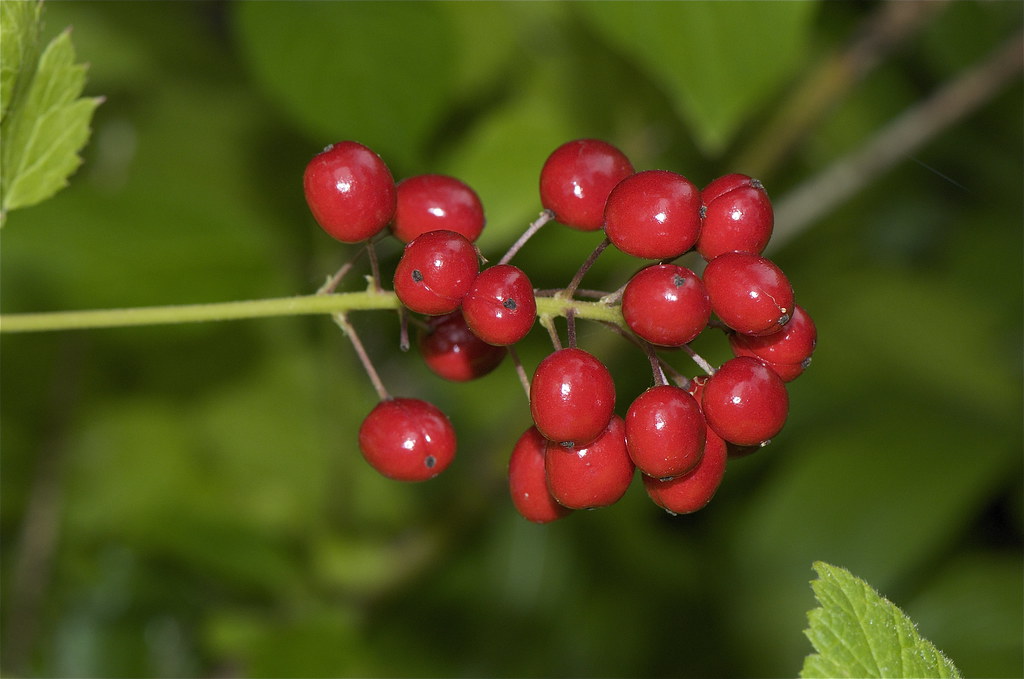
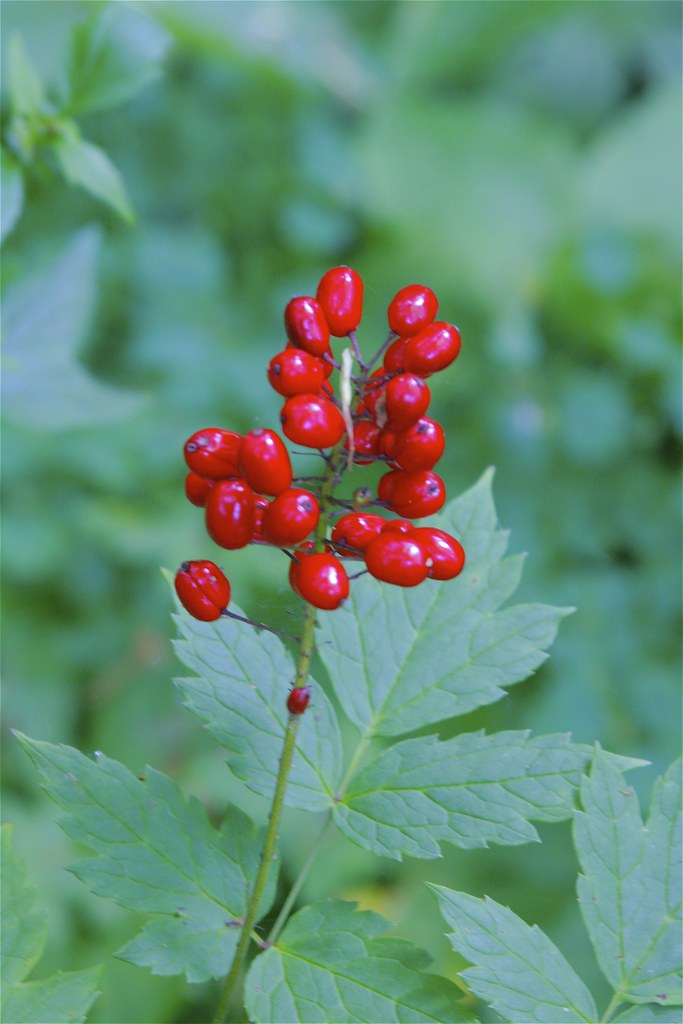
Look in rich, moist thickets and shaded forests for this striking, relatively uncommon plant.  It can grow up to three feet high, with flowers appearing in early to mid-summer as fluffy clusters atop tall stalks.  The white flowers have lots of antenna-like stamens that wave out past the small petals.  Soon, the flowers fade and stalks of bright red berries take their place.
The species and subspecies of Actaea are closely related and not always easy to distinguish.  There is a white baneberry (A. pachypoda), but the red baneberry species (A. rubra) sometimes bears white fruit as well.  True white baneberries have thicker pedicels (flower-bearing stalks) than the "red" species.  You can recognize Actaea berries by the little buttons on their ends.  The white berries, with their pupil-like spots, have been used in the past as eyes for children's dolls, hence one of the common names for the plant, "Doll's Eyes".      
Range:
Found through the northern temperate zones of North America and Eurasia.  In Montana, it's most likely to be spotted in the southern and western parts of the state (see the USDA range map)
What's in a Name?
The family name Ranunculaceae comes from the Latin rana, frog, in reference to its members' affinity for wet places.  Actaea is the Latin name for a generally strong-smelling plant.  The Greek aktea is the word for the elderberry tree (Sambucus sp.), whose leaves the baneberry resembles.  Rubra is a ubiquitous species name meaning "red".  The common name "baneberry" refers to its toxicity--bane ultimately comes from the ancient root gwhen-, "to murder or wound".
You might also hear baneberry called red cohosh, necklaceweed or snakeberry.    
                                                         Tidbits:
All parts of this plant are poisonous, with the toxin protoanemonin most concentrated in the berries and roots.  Symptoms include "the usual"--vomiting, diarrhea, dizziness, stomach cramps--but the toxin ultimately acts on your heart, and can cause circulatory failure.  So don't eat it!  That said, people have been eating this plant for thousands of years.  North American Indian tribes have used a decoction of the roots to treat rheumatism, coughs and colds, and to improve the appetite.  It is said to increase milk production after childbirth, and decrease excessive menstrual bleeding.  A poultice of chewed leaves was used to soothe wounds, and there are several references to it being ingested to soothe stomach pains caused from swallowing hair. (Huh?)  But once again, unless you're a trained professional, please, don't eat it.  Eating as few as two berries can cause severe pain, and a few more can mean respiratory failure and cardiac arrest.
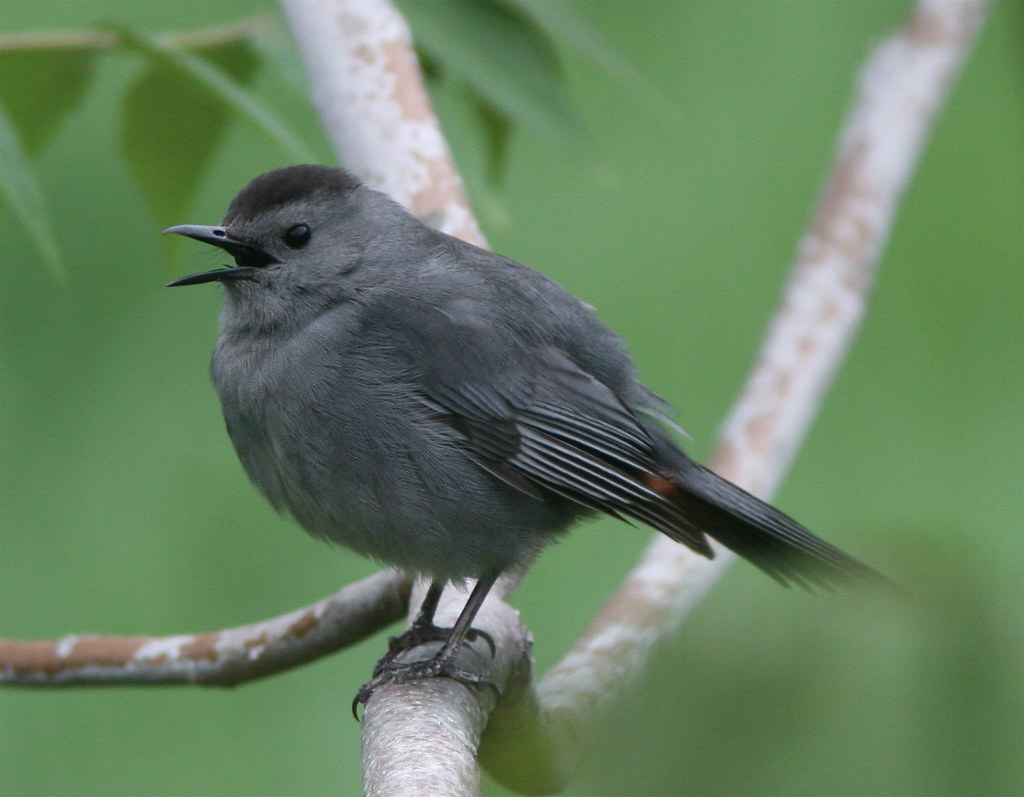
Baneberry is not, however, poisonous to livestock.  Sheep and horses will graze on it when there's not much else around, and elk will eat the foliage in the fall (Actaea foliage stays green late in the season, after most plants have withered in the frost).  Birds like Grouse, Gray Catbird (seen here), and American Robins also relish the berries, as do mice, squirrels, chipmunks and voles.
Wild Gardening:
Despite its murderous name, baneberry makes an excellent woodland garden perennial.  The foliage is lush, the flowers and fruit are highly ornamental, and it can take part to full shade.  It provides cover for small mammals and will attract songbirds to your yard.  Plants are not hard to find at nurseries, particularly those specializing in natives.  If you do decide to try propagating from seed, remember that, like many wildflowers, they need a period of cold stratification before they'll germinate, and it might take two seasons to get them to sprout.  Naturalize along with other moisture-loving species like twinberry, horsetail, thimbleberry, sedge, alder and aspen for a lush, verdant woodland garden.
Spotlight On... features Montana native plants that are currently on display in our natural areas.  Have a plant that you'd like to see featured?  Let us know!