14 September 2012

Friday Field Notes


Have you been wondering what’s going on around Missoula? Well, here’s a quick update on some natural history events occurring right in front of our eyes:

Fall Foliage

Although the gorgeous weather of late would have us believe that it’s still summer in western Montana, there are some signs that fall is on its way. Nighttime temperatures are dropping, the birds are stirring, and perhaps most noticeably, the leaves are beginning to turn. In just a few weeks, the Quaking Aspen and Western Larch trees that dot the mountainsides will shine gold, while the various maple trees found around town will fill the streets with shades of red and orange. Already, the larches have begun to turn a lighter green, indicating that it is only a matter of time before fall arrives.
Western Larch paint the hillsides gold
It is these vibrant colors and cooler temperatures that make fall one of the most pleasant times of the year in Montana. Indeed, fall gives us all a perfect excuse to get outside and put our naturalist skills to use.

Looking for ways to enjoy the turning of the seasons? Here’s some ideas:
  •         Take a walk through Greenough Park. The towering cottonwoods and other deciduous trees that line Rattlesnake Creek will be putting on a show.
  •         Go for a hike in the Rattlesnake National Recreation Area. Many trails in the Sawmill Gulch area climb high onto ridges that provide great views of the larch-covered hillsides.
  •         Up for a challenge? Climb the steep slopes above the “M” to the top of Mount Sentinel for great views of fall foliage throughout the Missoula area!

Feathered Flyby

Like the turning of the leaves, the annual migration of birds from their summer breeding range to winter habitat is imminent! Birds are already exhibiting pre-migration behaviors indicative of this great journey. Various species of sparrows, warblers, and other woodland songbirds have gathered into mixed-species flocks, which provide members of the group with greater protection and increased feeding efficiency. Additionally, large groups of ducks and other waterfowl can be seen congregating on lakes and wetlands. Because of this, fall is an incredible time to go birding. The many wildlife refuges found in the region, particularly in the Mission and Bitterroot valleys, provide countless opportunities to observe migratory birds.

 Migration isn’t all about the movement of vast flocks of birds from northern latitudes to warmer climates, however. For many species of birds found in western Montana, migration consists of simply moving down in elevation - rather than in latitude – to escape the harsh conditions of winter. Many of the birds that summer in the region, often nesting high up in the mountains, winter low in valleys and in our backyards! As a result, the movement of birds to lower elevations during fall and winter presents a great opportunity to see rare and unique birds that are secretive and elusive the rest of the year.

Numerous species of finches, including Pine Grosbeaks, Cassin’s Finches, and the stunningly colored Evening Grosbeak, become common sights at backyard bird feeders. In addition, many corvids - such as Steller’s Jays, Gray Jays, and Clark’s Nutcrackers – move to lower elevations where food is more readily available. In the coming weeks, listen for unusual calls or sounds; it could be one of these birds settling in to the valley for winter!

A flock of Evening Grosbeaks invades a Missoula backyard, 2010. 

 So Missoulians, get ready for the many wonderful changes fall brings to our home!

10 September 2012

Discover ways to involve yourself with MNHC this Fall!

photo by Merle Ann Loman

Visiting Naturalist Program

We're kicking off the program with introducing 3rd-grade students to bird beaks and feet and 4th- and 5th-grade students to the idea of naturalist as scientist, artist, and writer.  Staff naturalists visit the classrooms once per month throughout the school year, and lead activities that incorporate creativity with a scientific study of the natural world.  Volunteers are always needed (and appreciated) to help assist with classroom activities. 

miniNaturalist Program
Youngsters can come and discover the natural world all year round with our miniNaturalist program.  As brand-new naturalists, kids engage in nature with a series of sensory, imaginative and (sometimes) musical activities.  Last week, we talked about squirrels--what they eat, where they live and who might eat them.  Our miniNaturalists taste-tested seeds, learned about squirrel habitats and became a squirrel in their own Squirrel Play Production. The miniNaturalist Program is offered every first and third Thursday at MNHC from 10 a.m. to 11 a.m.  Admission is $3/non-member and $1/member.   

A Forest for Every Classroom
Don't worry, teachers, we won't let the kids have all the fun.  MNHC offers teachers a unique opportunity to learn about place-based education through seminars and workshops.  In the past, teachers have traveled to various places around western Montana, including Tarkio, the Blackfoot Valley, Seeley Lake, and the Bitterroot Valley, and met with various scientists, ecologists, forest service specialists, naturalists, ranchers, and conservationists.  This year-long program has two- three-day workshops in every season, which are designed to inform educators about what is going on in Montana's natural environment and how they can incorporate place-based education within their own curriculum. Educators are provided with supplemental course materials which offer a range of activities that can be used to teach children about anything from the wildlife diversity to patterns of change within the environment. We are currently recruiting interested educators  to be a part of our new workshop session which will begin in April 2013.

Fall Celebration and Auction
Celebrate with us on October 5 at the DoubleTree Hotel starting at 5 p.m.  There will be a silent and live auction with items graciously donated from artists, restaurants, designers, jewelry makers, and businesses throughout Montana.  Don't worry if you get tired from all that auction bidding, because the dinner menu includes salad, your choice of entree and a cookie sundae with Big Dipper Ice Cream.  If you're interested in attending we've made it easy!  Log onto our website at http://www.montananaturalist.org/ and follow the link to register and reserve your spot.

Interested in volunteering, learning about our programs or checking to see what's new?
Please contact MNHC Tuesday-Friday 12-5 at 406.327.0405

07 June 2012

VNS May Field Trips: Insects, Part 2--Beetles!


There are 450,000 species of beetles, and they make up 40% of all insects. So, I hope you'll forgive me for not being able to identify all of the species we saw on our field trips! We caught some amazing specimens: brightly colored ones, iridescent ones, and just plain adorable ones. The kids were superb insect collectors, and only a few bugs were accidentally crushed in the excitement (one of which, I will admit sadly, was a sneaky common cricket that I was trying to recapture). I will do my best at telling you what I know about the beetles I got pictures of--or about beetles in general.

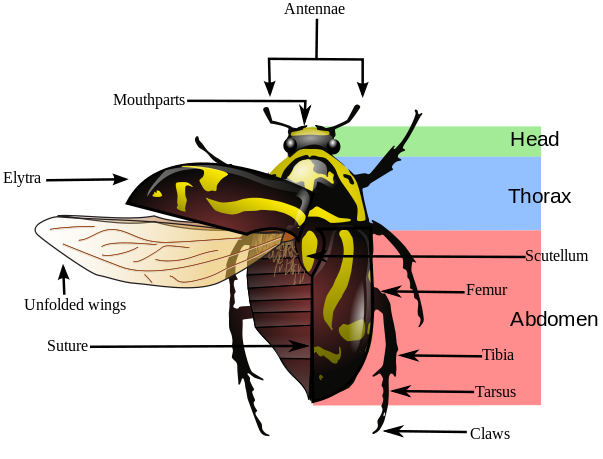
Here are the basic body parts of beetles, which I will refer to below. What isn't illustrated in the diagram is a section called the pronotum, or a portion of the front-most surface of the thorax. The shape and size of this feature is often very helpful in the identification of beetles.


Beetle #1: The lime green one on a pencil. 
Truly, I do not know what kind of beetle this is. It was a vivid, lovely color, though, and the kids who found it were ecstatic. 

 Beetle #2: The funny-colored lady beetle. Or, what reminds me of a Colorado Potato Beetle.
 This one came and landed right on my bracelet. He is shaped just like a lady-beetle--and there are 150 species of "ladybugs" in the U.S., so he very well could be one!

Entomologists think that lady-beetles may have spots to warn predators that they taste bad and can make them sick. See, ladybugs make a little bit of poison--just a little--and birds may be able to learn that a spotted beetle equals a terrible taste and illness.    

I'll admit, being a girl from a farm, my first thought was, wow, what a funny little, spotted Colorado potato beetle. Thankfully, this guy's pronotum and coppery-brown color set him off as something different. He's lovely, isn't he?

Beetle #3: A metallic-colored ground beetle (perhaps?)
If you Google the colors of this beetle (metallic green and copper-brown), you will get results for the notorious Japanese beetle--but this guy's colors are inverted and his shape is not the same. 


Do you know any of these beetles? If you do, tell us about them in the comments! We'd love to know!

06 June 2012

VNS May Field Trips: Insects, Part 1.

The insects station is, by far, the most active one in the spring. Sure, the hikes have lots of walking, but at the insect station, we wander around, run with nets, dump and scoop bugs with caution and speed, and work hard to draw and inspect. We don't really try to ID, but, as you will find, it is difficult not to know what to call a specimen we find. Naming something, however, is only part of the process, and  being able to describe it or draw it in detail is also important. Simply observing and marveling at something is worthwhile, too!

Christine W. helping with a multitude of bugs!
After the sometimes cold and often surprising weather of the first two weeks of field trips, things warmed up, the sun came out, and jackets were shed or tied around waists and we were able to focus on the bugs in the nets and crawling around on us. At least, in theory, we could focus. Sometimes we had insects in a bunch of places, which led to a multitude of things going on all the time.

This little guy is an Anthocharis stella, or a Stella orangetip, butterfly. Along the Pacific coast, the subspecies is a Sara orangetip, and the Stella was thought to be a subspecies; but recently, scientists discovered that the two (Sara and Stella) will cohabitate without hybridizing. You can tell the difference, I've learned, by the color of their marbeled underwing: Saras are darker grey-green, and Stellas are pale mossy-green.

In general, though, you can just call them all orangetip butterflies, if you'd like.


They are such beautiful little creatures! Variations of this species are found all over the world. In some, the females are white, like cabbage moths. In others, like these, both males and females have orange tips, but males have more pronounced dark borders on white wings, while females have a yellowish tint and lighter mottling on the underside of their wings.


Isn't that wing marbling neat?


Look at this grasshopper we found! He was bright green with brown legs, wings, and eyebrows. No really--he had eyebrows! It was very cool.

Now, there are at least 11,000 verified species of grasshoppers (Kevan 1982; Günther, 1980, 1992; Otte 1994-1995; subsequent literature), but still, I'm going to go out on a limb and try to identify him. I think he's some sort of band-winged grasshopper. I didn't stretch out his wings, but if I had, I bet I would have found bands of color on them.


The kids absolutely had a blast! Look at these little naturalists!

05 June 2012

VNS May Field Trips: Solo Hike.

Students on the solo hike get to put their naturalist skills they've learned to practice--all on their own. I heard many students say that they were surprised by how much they enjoyed being alone on a trail. A few times, they insisted they walk back along the solo hike trail in the opposite direction, again all alone.

Some discoveries:

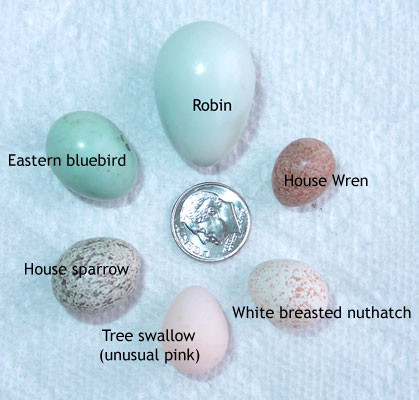
A tiny, blue egg. I found it along the trail at Fort Missoula, and have yet to get a confirmation of what kind of bird it belongs to! Of course, it is most probable that it was a robin's egg--but it was definitely no bigger than a quarter. Could it have belonged to someone else?


 Here's a chart I found of the sizes of eggs (some of which are blue) from someone in Connecticut. An Eastern bluebird egg is the same size, approximately, as a Western or mountain bluebird.

http://www.sialis.org/nests.htm
European Starlings can also have blue eggs. Their eggs are darker and smaller than robins' eggs, a little larger than a bluebird egg, and glossy, but without any spotting. If you want to have a go at IDing the egg we saw, do so in the comments!


 This group of kids at Council Groves enjoyed walking alone, and really loved skipping rocks along the river afterwards. They seemed so enthralled by being alone that I had to run around to gather them back togther to share their discoveries from the solo hike!
 

 At Fort Missoula, kids ate their snacks all crammed into the big log. These girls were all telling each other about things they had seen, and it from a ways off it seemed like the log itself was chattering.


04 June 2012

Spring at the MNHC!

As Allison said, so many exciting things have been happening this spring!

May ushered in the time of the year when we hold field trips for our Visiting Naturalist in the Schools program. This year, I had the opportunity to help with field trips held at Council Groves, Maclay Flats, and the Native Plant Garden at Fort Missoula, but field trips were also going on at a few other places. All hands were on deck. The warm weather (or, mostly warm) brought lots of exciting animals and plants out and about for all the naturalists to see.

For those of you who don’t know, Visiting Naturalist in the Schools is a program for grade schoolers (mostly fourth graders) aimed at helping young students develop their artistic, writing, and scientific skills to explore the world as naturalists. We do two “field study” sessions; the first is in October and the second is in May. Slightly different stations occur depending on the season. In May, we have three stations: the wildlife hike, the solo hike, and the insect study. These stations at the end of the year are especially exciting because we get to put all of the lessons we learned throughout the school year into practice. 

The next few posts are all about a few of the very exciting things we saw and experienced during VNS field trips in May!

Community Observations: What are you seeing?

Spring has arrived in a glory of rain and sun and flowers and green things growing.  It's a great time to be out and about, observing the natural world!  The staff at MNHC have been seeing lots of fun things:  Great Horned Owl young in a nest at Council Grove; Lazuli Buntings at Bass Creek in the Bitterroots; American Dippers braving wild run-off waterfalls along Sweathouse Creek; Osprey soaring over the Clark Fork River, looking for fish; the bright colors of Western Tanagers in back yards around Missoula; and dozens and dozens of wildflower species, from lupine to paintbrush to side-flowering mitrewort to fairy-slipper orchids.  


Where are you exploring this spring?  What are you seeing?  Please share in the comments!